
Iridology Chart High Resolution: Complete Professional Guide for Practitioners and Educators
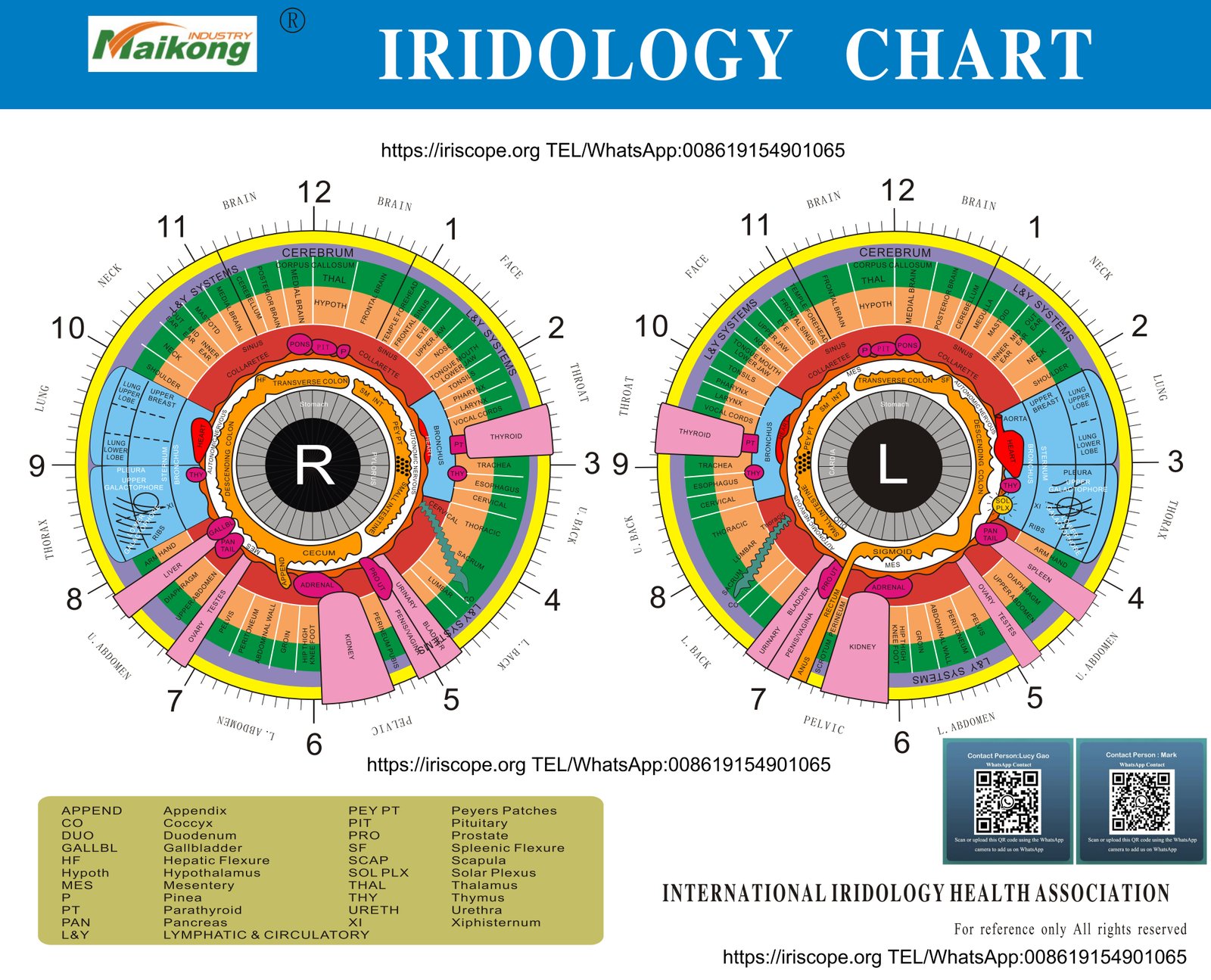
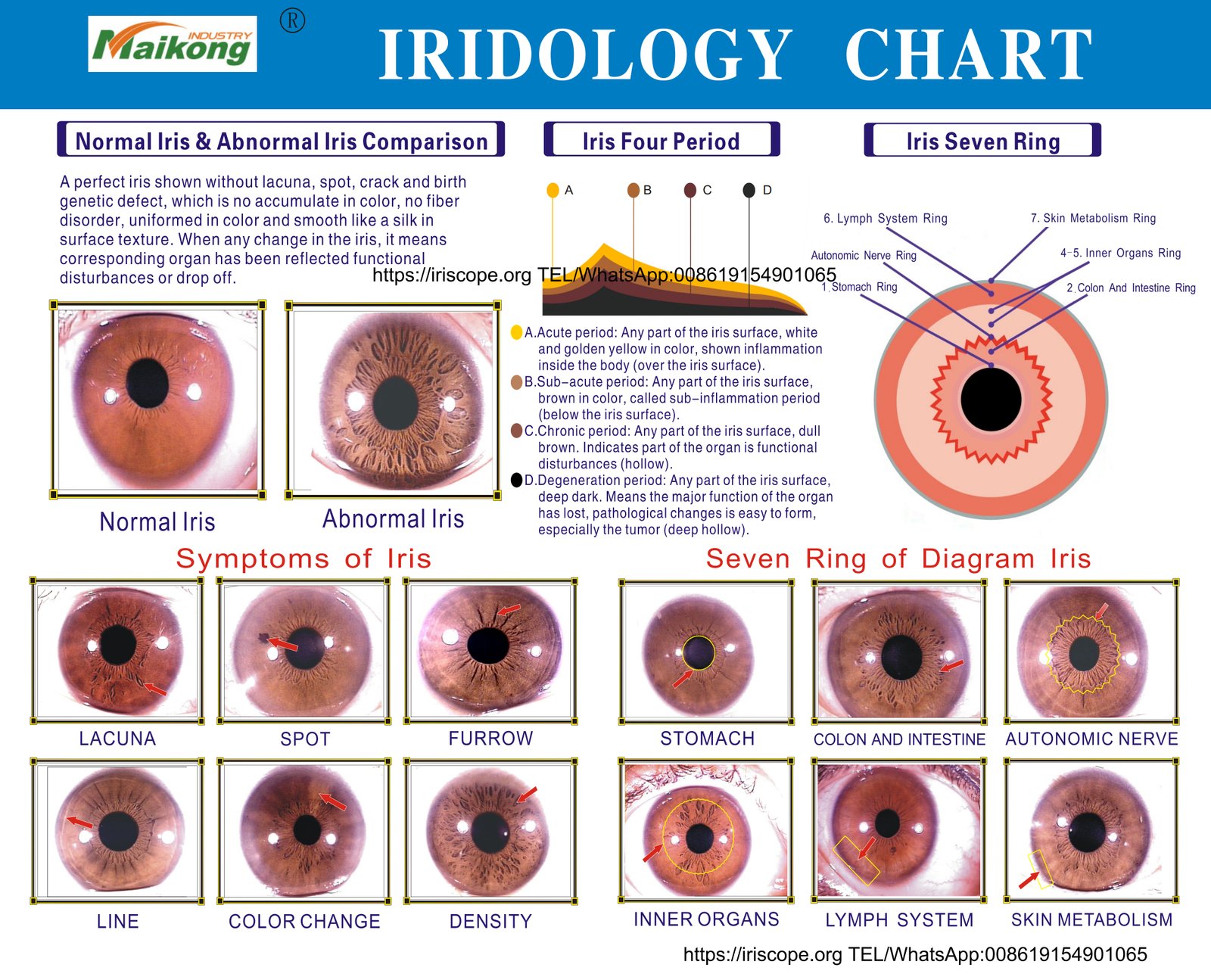
When you search for an iridology chart high resolution, you need more than just a simple image. You need a professional-grade resource that clearly shows iris zones, organ correlations, and detailed markings for accurate traditional iridology observation. As someone working in the natural health field, I understand that the quality of your chart directly impacts your ability to educate clients, students, or colleagues about iris patterns and their traditional interpretations.
A true high resolution iridology chart serves multiple critical purposes. It functions as a teaching tool in training environments. It helps practitioners communicate complex iris zone concepts to clients. It provides a reference point during iris photography sessions. Most importantly, it maintains clarity when enlarged for presentations or printed for clinical wall displays.
Through my two decades of experience manufacturing iridology equipment at MAIKONG in SZ, GD, I have worked with over 1,000 practitioners, clinics, and training institutions worldwide. They all share one common requirement: charts that remain sharp and readable at any size. This guide will walk you through everything you need to know about selecting, understanding, and using high-resolution iridology charts in professional settings.
Important Note: All information in this article relates to traditional iridology observation and educational reference. Iridology charts are tools for iris zone study and client communication, not medical diagnostic instruments. They do not replace professional medical examination or diagnosis by licensed healthcare providers.
Understanding What Makes an Iridology Chart “High Resolution”
The term “high resolution” in iridology chart high resolution refers to specific technical standards. Resolution determines how much detail an image can display. For iridology charts, this means the ability to show individual iris fibers, subtle color variations, and precise zone boundaries.
Resolution Standards for Professional Use
Professional iridology chart images should meet minimum resolution standards. For digital viewing on monitors, 1920×1080 pixels works for basic reference. For printing at poster size, you need at least 300 DPI (dots per inch) at the final print dimensions. A chart intended for 24×36 inch printing requires a source file of approximately 7200×10800 pixels.
I have seen practitioners struggle with pixelated charts that look acceptable on screen but turn into blurry messes when enlarged. The zones become undefined. The text becomes unreadable. The educational value disappears. This is why I always recommend confirming actual pixel dimensions before using any chart for professional purposes.
File Format Considerations
The file format impacts both quality and usability. Iridology chart PNG files support transparency and maintain quality without compression artifacts. This makes them ideal for overlaying on iris photographs or integrating into software interfaces. JPEG files work for basic viewing but can introduce compression artifacts that blur fine details.
Vector formats like SVG offer unlimited scaling without quality loss. However, most traditional iridology chart images exist as raster formats. When selecting charts, I prioritize PNG format for its balance of quality and compatibility across different platforms and applications.
Color Accuracy and Clarity
A large iridology chart must maintain accurate color representation. The iris displays subtle color variations that traditional iridology associates with different tissue conditions. If your chart shows inaccurate colors due to poor quality or low resolution, it misleads your observations and client communications.
High-resolution charts preserve these color subtleties. They show the difference between a true brown iris and a mixed iris. They display lacunae (gaps in iris fibers) clearly. They represent nerve rings, pigment spots, and other iris features with the clarity needed for educational accuracy.
Types of Iridology Chart High Resolution Formats Available
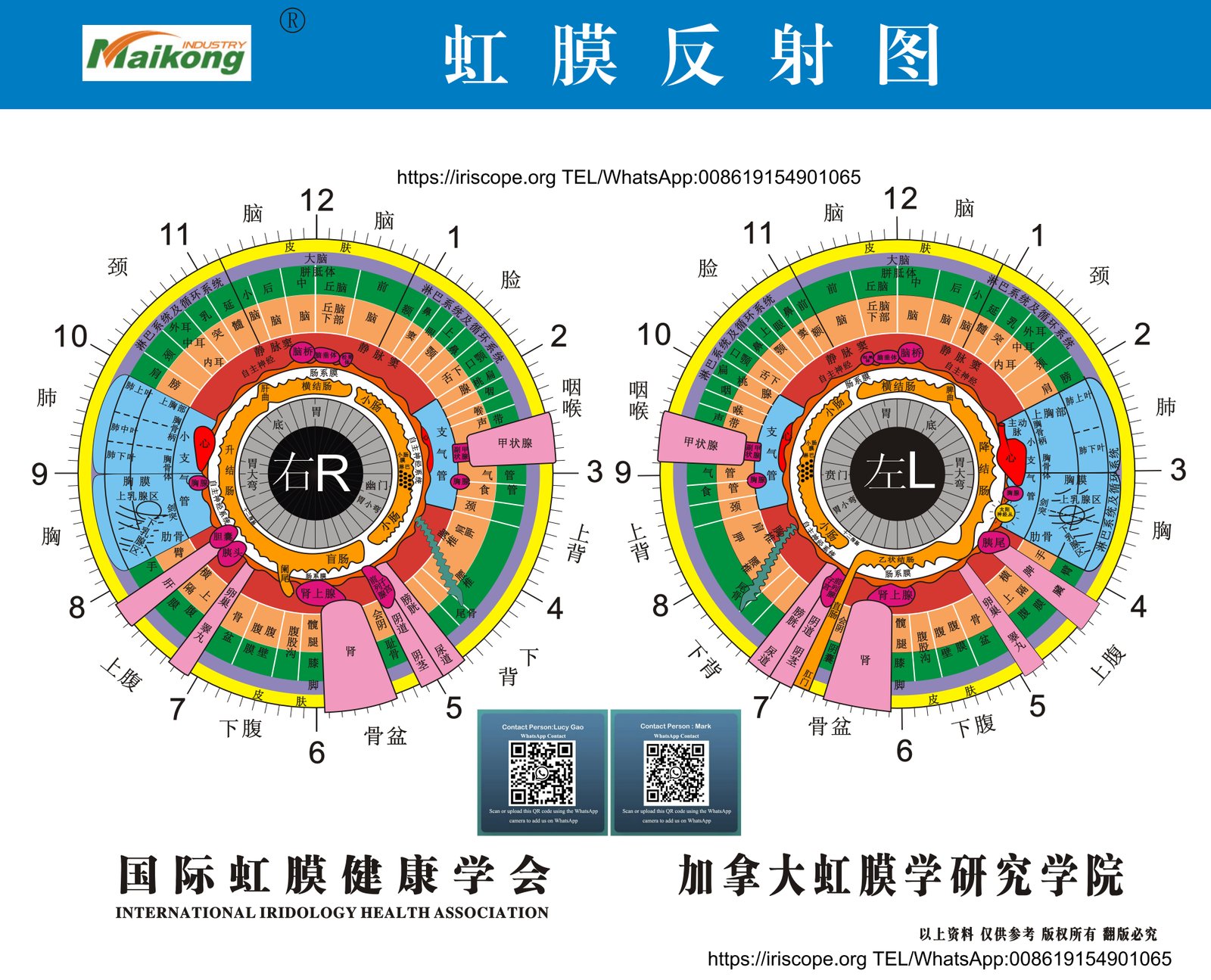
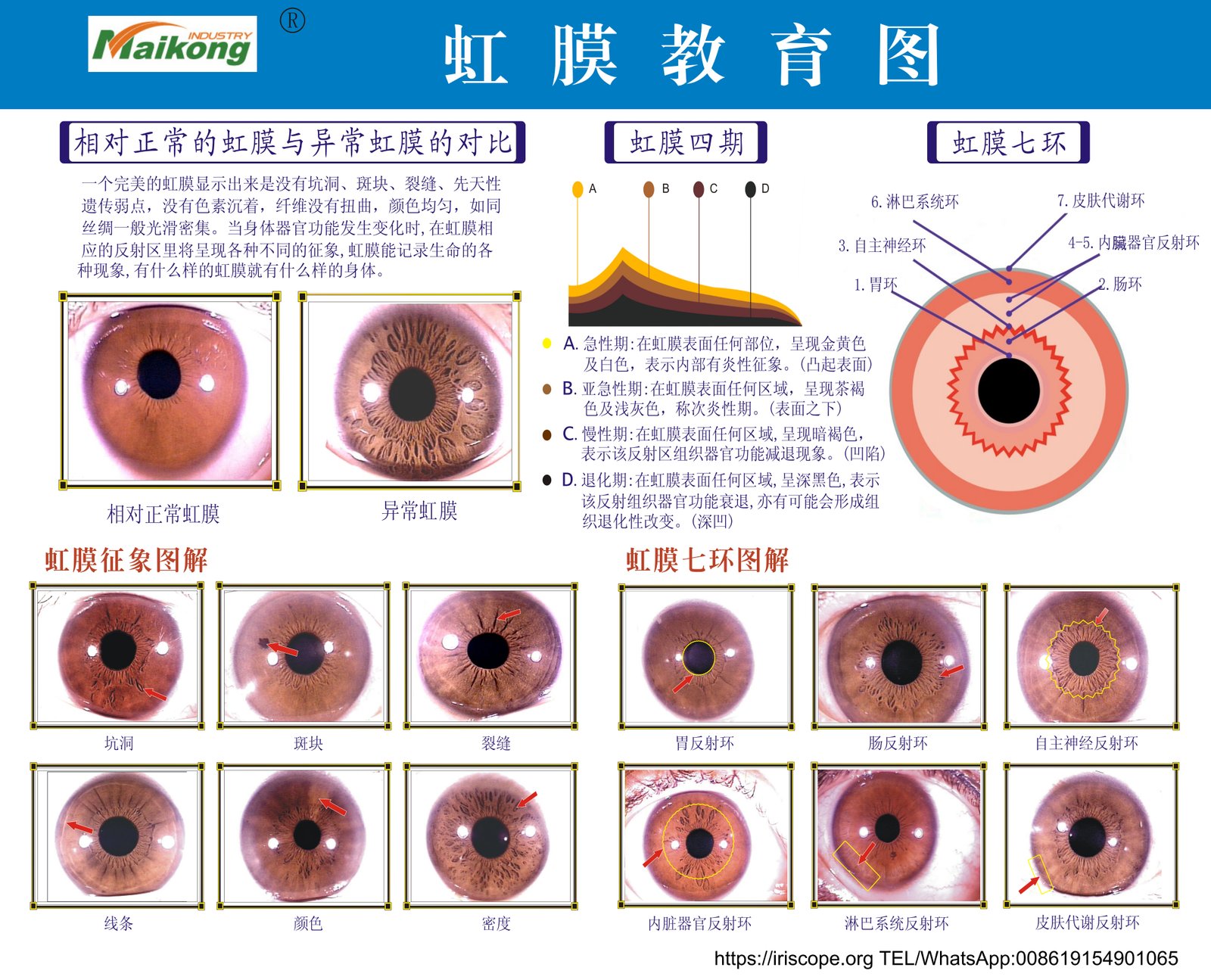
Several distinct chart types serve different purposes in iridology practice. Understanding these variations helps you select the right iridology chart high resolution resource for your specific needs.
Bernard Jensen Iridology Chart
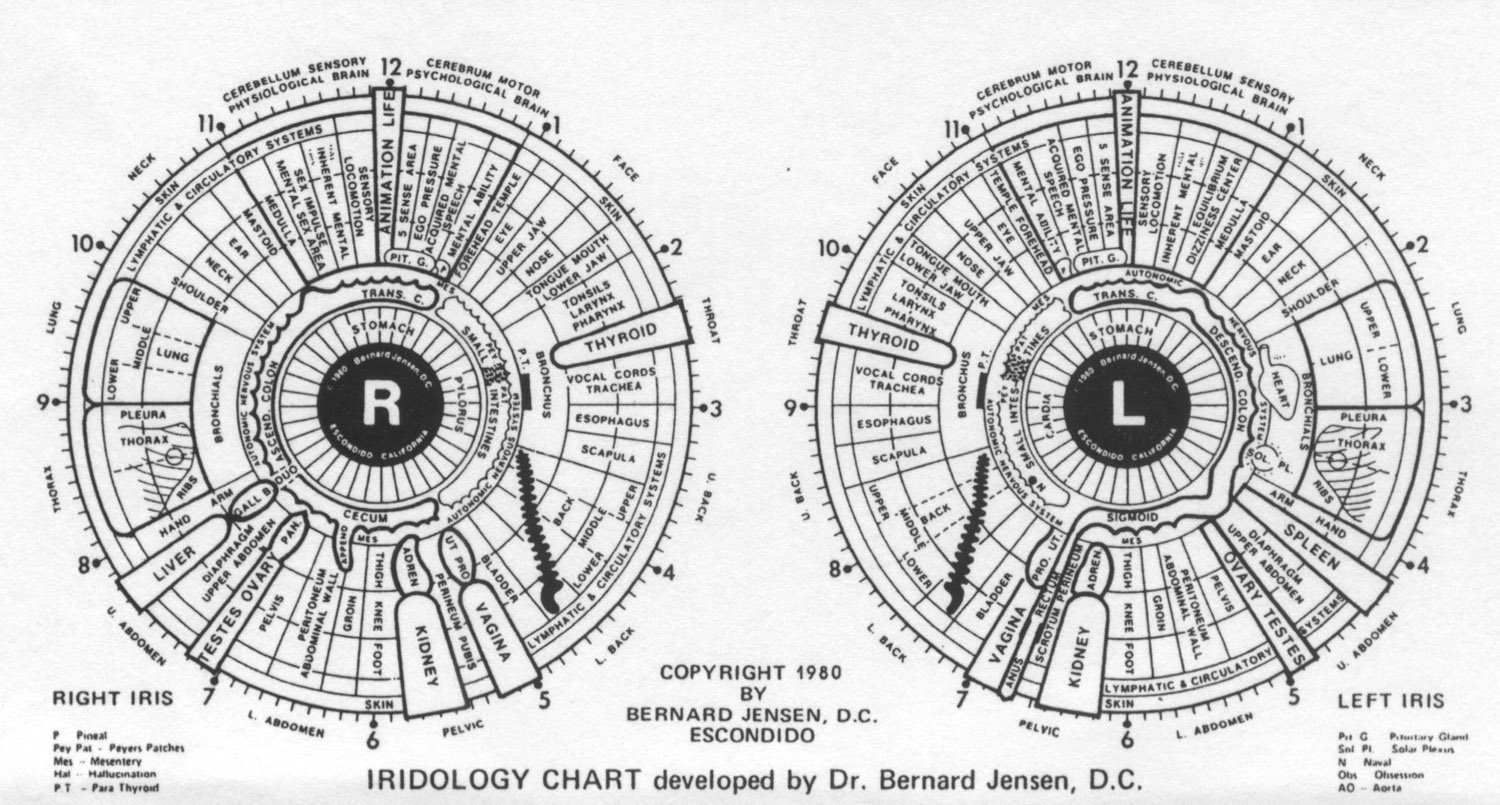
The Bernard Jensen iridology chart represents one of the most widely recognized formats in traditional iridology. Dr. Jensen developed his chart system through decades of iris observation and documentation. His charts show organ zones arranged in a circular pattern corresponding to the 12 o’clock through 11 o’clock positions.
I have provided countless Bernard Jensen format charts to training schools and clinics. Students appreciate the clear zone labeling and the systematic organization. Practitioners value the historical foundation and the extensive body of traditional knowledge associated with this chart style. When you request a large iridology chart for wall display, the Bernard Jensen format often serves as the primary choice.
Left Eye and Right Eye Specific Charts
Traditional iridology differentiates between left and right iris zones. The left eye iridology chart and right eye chart show mirror-image zone arrangements. Each eye correlates to specific body areas based on traditional zone mapping systems.
The right iris traditionally correlates to the right side of the body in traditional iridology mapping. The left iris correlates to the left body side. Certain organs appear on both charts while others appear only on one side. For example, the heart zone typically appears on the left iris chart, while the liver zone appears on the right iris chart.
Professional practitioners need both charts for complete reference. I always recommend obtaining paired left-right chart sets rather than generic circular charts that don’t specify eye laterality. This precision matters when documenting observations and communicating findings to clients.
Transparent Iridology Chart Overlays
A transparent iridology chart serves a specialized function. These charts use a PNG format with transparency, allowing them to overlay directly onto iris photographs. When you capture an iris image with an iridology camera, you can superimpose the transparent chart to align zones with actual iris features.
This iridology transparent overlay approach works particularly well in client consultations. You can show the client their actual iris photograph with zone boundaries visible. This visual connection helps them understand which areas of their iris you are observing and discussing.
In my experience manufacturing iridology equipment, I have seen the transparent overlay function become increasingly popular in modern practice. Our iridology software includes this feature specifically because practitioners find it invaluable for client education and documentation.
Simplified Educational Charts
Some iridology chart large formats simplify zone information for introductory education. These charts show major organ systems without the detailed sub-zones found in professional reference charts. They work well for health fairs, introductory workshops, and client waiting rooms.
While I value comprehensive charts for professional use, I also recognize that simplified versions serve important purposes. A complex chart can overwhelm someone new to iridology concepts. A simplified version introduces the basic principle that different iris areas correspond to different body systems in traditional zone mapping.
How to Read Iridology Chart High Resolution Images Step by Step
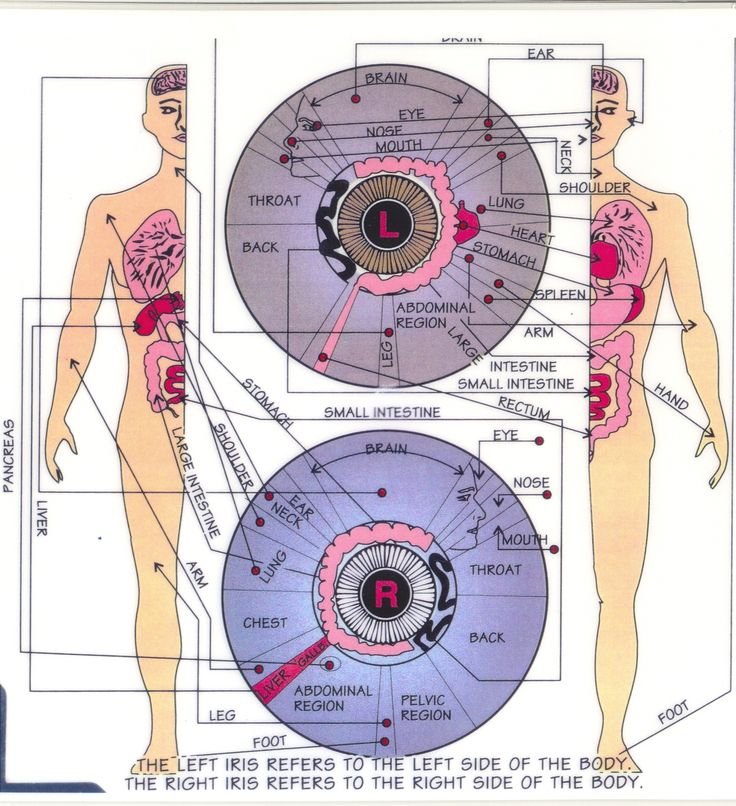
Reading an iridology chart high resolution image requires understanding the basic organization principles. Let me walk you through the systematic approach I teach to new practitioners and students.
Understanding the Clock Position System
Most iridology charts organize zones using clock positions. The 12 o’clock position sits at the top of the iris. Positions proceed clockwise around the iris circle. Each organ or body system occupies specific clock position ranges.
For example, in many traditional charts, the brain and nervous system zones appear at the top (around 12 o’clock). Digestive system zones often appear in the central portions. Skeletal and structural system zones typically appear toward the periphery.
When you first look at a high-resolution chart, identify the 12 o’clock marker. This orientation point allows you to locate all other zones systematically. I always advise beginning students to practice finding three or four major zones until the clock position concept becomes natural.
Identifying Zone Rings from Center to Periphery
Beyond clock positions, iridology charts organize zones in concentric rings. The pupil sits at the center. The area immediately surrounding the pupil forms the stomach ring in many traditional chart systems. Moving outward, you encounter intestinal zones, then organ zones, then structural zones at the outer periphery.
A true high resolution iridology chart clearly delineates these ring boundaries. You should see distinct lines or shading that separates one ring from another. This radial organization combines with the clock position system to create a grid-like reference system across the iris surface.
Correlating Chart Zones to Iris Observations
The practical application involves comparing actual iris features to chart locations. When you observe a marking, color variation, or structural change in a specific iris area, you reference the chart to identify which traditional zone contains that feature.
I emphasize that this correlation serves educational and observational purposes. You are noting which zones show iris variations according to traditional iridology mapping. You are not diagnosing medical conditions. You are documenting iris characteristics in relation to traditional zone assignments.
This process works best when you use an iridology camera to capture clear iris photographs. You can then apply a transparent iridology chart overlay to precisely align zones with observed features. This combination of quality imaging and high-resolution chart reference creates the foundation for systematic iris observation.
Recognizing Common Iris Markings on Charts
High-quality charts often include reference images showing common iris markings. These might include representations of nerve rings (circular patterns), lacunae (fiber separations), pigment spots, and texture variations. Understanding what these markings look like on the chart helps you recognize them in actual iris observations.
During my years working with practitioners, I have noticed that the ability to identify specific iris features improves dramatically when students have access to well-labeled, high-resolution reference charts. The clarity allows them to study subtle differences between marking types.
Integrating Iridology Chart High Resolution Resources with Professional Equipment
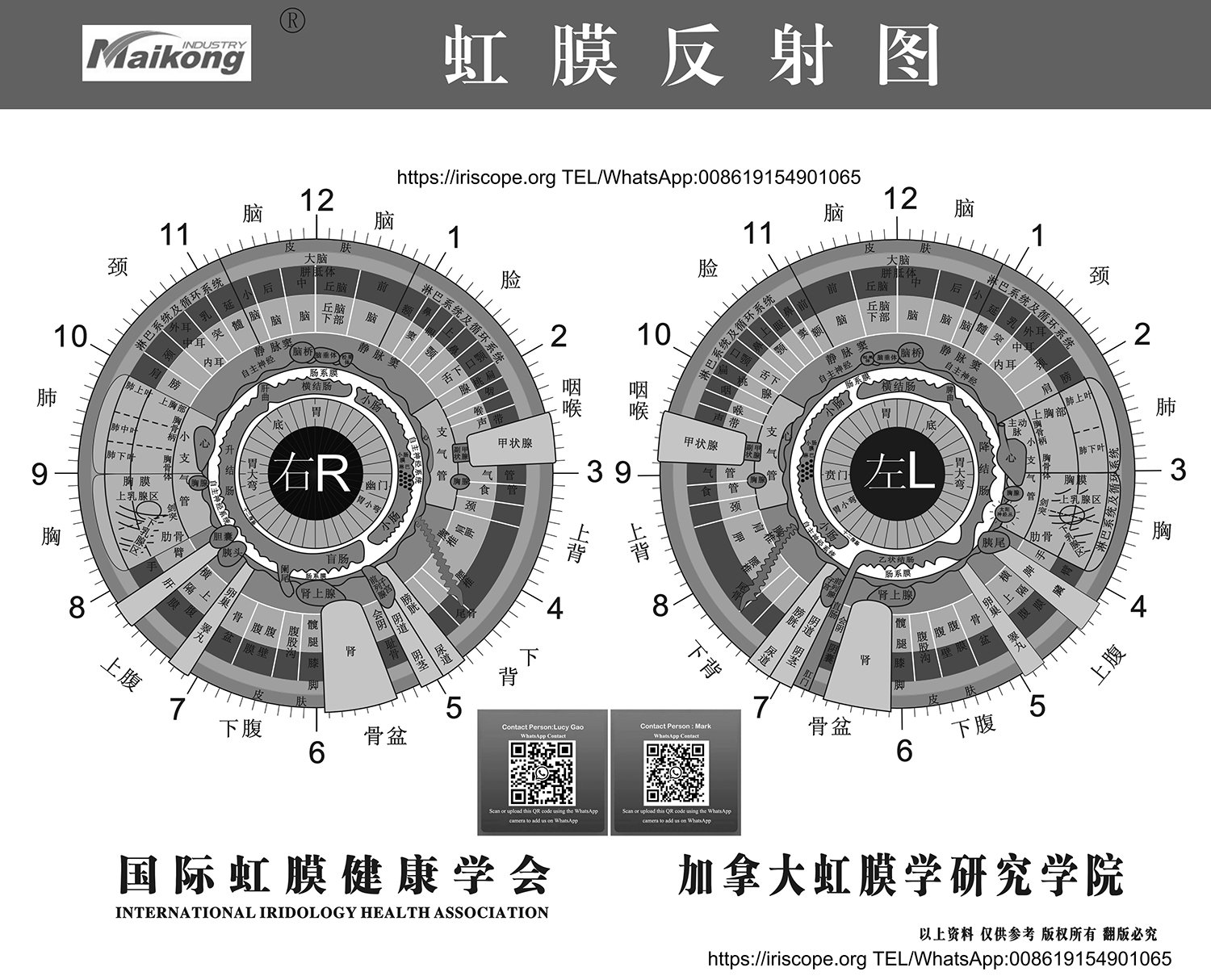
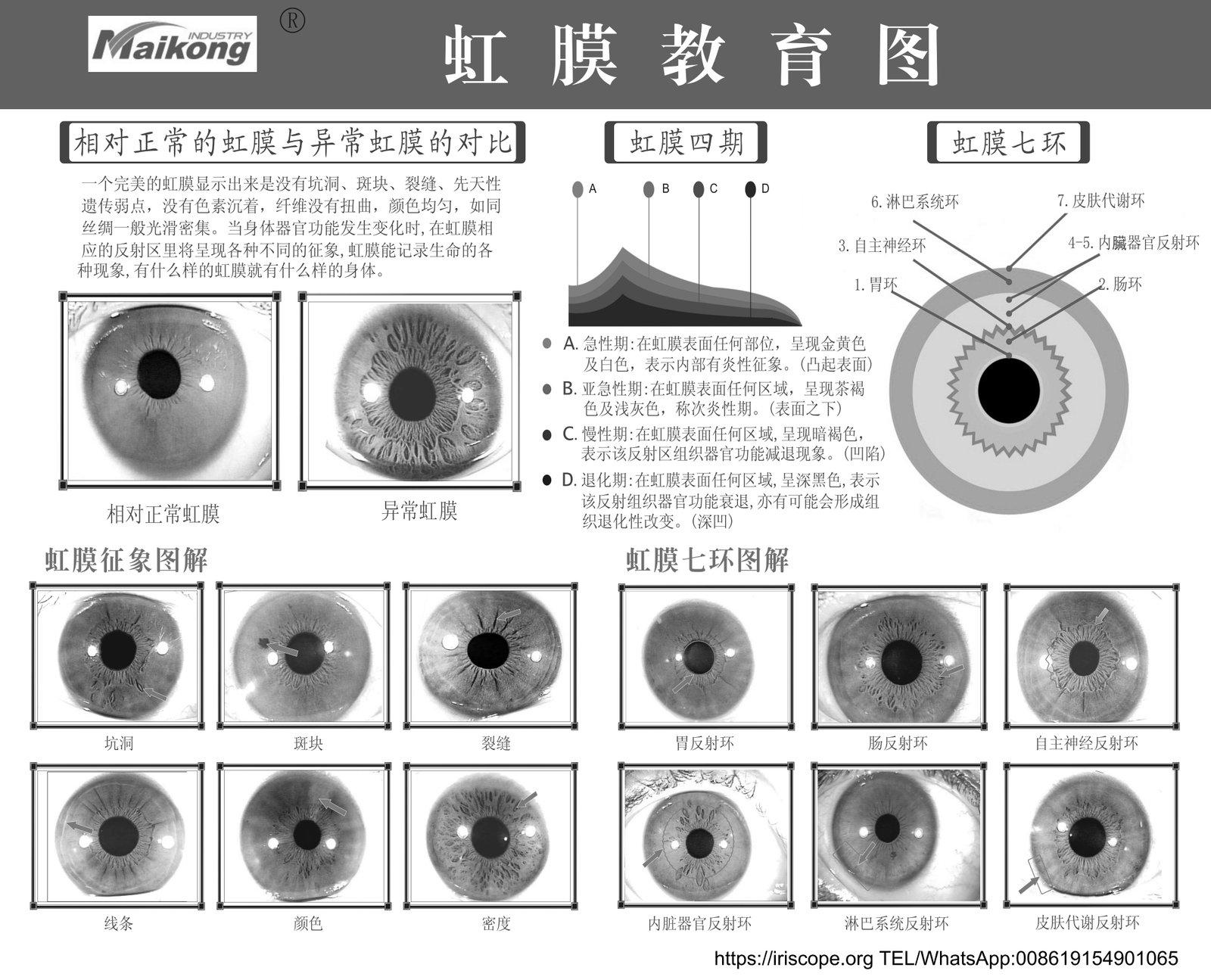
The real power of iridology chart high resolution resources emerges when you integrate them with professional iridology equipment. This integration creates a complete system for iris observation, documentation, and client education.
Chart Display with Iridology Cameras
Modern iridology cameras connect directly to computers. This connection allows simultaneous display of the live iris image and a reference chart. I have designed many of our MAIKONG camera systems specifically to support this dual-display workflow.
When you capture an iris photograph, you can immediately reference the chart to identify zone locations. The high resolution quality ensures that both the photograph and the chart maintain clarity side by side. Clients can see their own iris alongside the educational chart, creating a powerful visual learning experience.
Our iriscope systems include chart reference capabilities built into the hardware and software package. This integration eliminates the need to switch between separate chart files and camera software. Everything operates within a unified interface.
Software Integration and Overlay Functions
Advanced iridology software incorporates chart overlay features. You load an iris photograph, and the software superimposes a transparent iridology chart directly onto the image. You can adjust the overlay size, rotation, and opacity to achieve perfect alignment.
This overlay function requires high-quality chart files. A low-resolution chart becomes pixelated when enlarged to match iris photograph dimensions. A iridology chart PNG file with sufficient resolution maintains crisp lines and readable text at any size.
I have developed our MAIKONG software to support chart customization. Practitioners can load their preferred chart style, whether Bernard Jensen format, European zone charts, or other traditional mapping systems. The software stores these charts for instant access during client sessions.
Equipment Specifications
Our professional iridology systems combine high-resolution imaging with integrated chart resources. Here are the specifications for our current equipment line:
| Specification | Details |
| Camera Model | MAIKONG MK-9822U |
| Resolution | 12.0 Megapixels |
| Sensor Type | CCD with DSP Processor |
| Lens | 30X Iris Lens (Imported, Multi-Coated) |
| Illumination | Adjustable LED Ring Light |
| Focus | Manual Adjustable |
| Connection | USB 2.0/3.0 |
| Power | USB Powered (No External Supply) |
| OS Compatibility | Windows XP/7/8/10/11, macOS 10.14+ |
| Software Features | Chart Overlay, Client Database, Report Generation |
| Included Charts | High-Resolution Digital Charts (17 Languages) |
| Warranty | 13 Months |
Printable Chart Resources for Clinical Display
Many practitioners want physical iridology chart printable versions for wall display in consultation rooms. A printable chart must maintain resolution quality when enlarged to poster dimensions.
I recommend printing charts at a minimum of 24×36 inches for clinical wall display. At this size, clients can see zone details clearly from several feet away. The chart serves as an educational tool during consultations and as a visual reminder of the iris-body zone concept.
For printing purposes, request the highest resolution version available. A file that looks adequate on screen may reveal pixelation when printed at large sizes. I have seen practitioners disappointed when their printed charts showed blurry text and unclear zone boundaries due to insufficient source resolution.
Digital Display Systems
Some modern clinics use large digital displays instead of printed posters. A wall-mounted monitor can display rotating iridology chart images along with educational videos and practice information. This approach allows you to switch between chart types and update content without reprinting.
Digital displays require high-resolution files to look professional. A 4K monitor (3840×2160 pixels) can fully utilize a high-resolution chart without any quality loss. Lower resolution charts may appear acceptable on smaller screens but show obvious pixelation on large 4K displays.
Professional Applications of High Resolution Iridology Charts
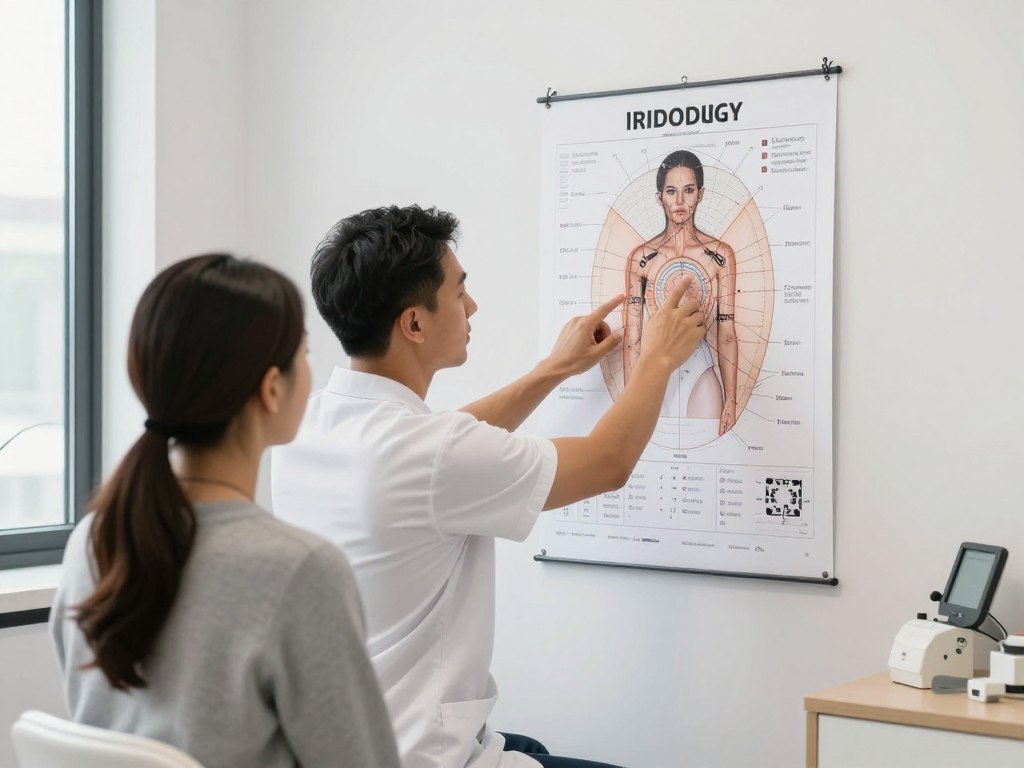
Understanding the various professional applications helps you select and utilize iridology chart high resolution resources effectively. Different contexts require different chart characteristics.
Educational and Training Environments
Iridology training schools and certification programs rely heavily on clear, detailed charts. Students need to study zone locations, memorize organ correlations, and understand the traditional mapping systems. A large iridology chart displayed in a classroom provides a constant visual reference during lectures and practical sessions.
I have supplied educational institutions with both physical printed charts and digital chart files. Schools often request multiple chart styles so students can compare different traditional approaches. The Bernard Jensen format, European zone systems, and modern variations each offer unique perspectives on iris zone mapping.
Training programs also benefit from iridology chart printable handouts. Students can take home study copies for personal review. These handout versions must maintain sufficient resolution to remain readable when printed on standard letter-size paper.
Clinical Practice and Client Consultations
In clinical practice, charts serve multiple purposes. Wall-mounted charts create a professional atmosphere and spark client curiosity. Many clients ask about the chart, providing a natural opening to explain traditional iridology concepts and the observation process.
During consultations, practitioners reference the chart to show clients which zones correspond to their questions or concerns. The visual element helps clients understand the traditional zone mapping concept. When you point to a specific area on the chart and then show the same area on their iris photograph, the connection becomes clear.
I always recommend using a transparent iridology chart overlay during client sessions. This overlay allows you to mark specific features on the client’s iris photograph while maintaining zone reference visibility. The combined image becomes part of their permanent file for future comparison.
Marketing and Practice Promotion
High-quality iridology chart images enhance practice marketing materials. You can include chart graphics in brochures, website content, and social media posts. These images visually communicate your specialized skills and the unique nature of iridology observation.
Health fairs and community events provide opportunities to display educational charts. A professional-looking large iridology chart attracts attention and generates questions. People are naturally curious about the eye-body connection concept, and a clear visual representation facilitates conversation.
When selecting charts for marketing purposes, I recommend formats that balance detail with simplicity. Overly complex charts may confuse newcomers. A chart showing major organ zones with clear labeling works better for general public education than a highly technical reference chart.
Product Integration and Equipment Demonstrations
For distributors and retailers of iridology equipment, charts play a crucial role in product demonstrations. When showing an iriscope or iridology camera to potential buyers, you need to demonstrate the complete workflow including chart reference integration.
I have trained hundreds of distributors in equipment demonstration techniques. The demonstration becomes much more compelling when you can show how the camera captures high-resolution iris images and how the software overlays charts for immediate zone identification. This integrated presentation shows the complete value proposition.
Equipment packages benefit from including high-quality chart resources. When a practitioner purchases an iridology camera system, they should receive professional-grade charts as part of the package. This completeness eliminates the need to search for separate chart resources and ensures compatibility between the camera system and chart formats.
Access Professional-Grade Iridology Chart Resources
As a direct manufacturer of iridology equipment, MAIKONG provides high-resolution iridology charts in multiple formats and languages. Our charts integrate seamlessly with our camera systems and software. We offer customization options for training institutions, clinics, and distributors who need branded chart versions.
Customization Options for Iridology Chart High Resolution Files
One significant advantage of working directly with a manufacturer like MAIKONG is access to chart customization services. Standard charts work for many applications, but customized versions offer distinct advantages for specific professional needs.
Language Localization for International Practice
Our iridology software supports 17 languages. We provide corresponding iridology chart high resolution files in each language. This localization allows practitioners to serve diverse client populations with charts in their native languages.
Language options include English, Spanish, French, German, Italian, Portuguese, Russian, Polish, Czech, Bulgarian, Japanese, Korean, Malaysian, Persian, Simplified Chinese, and Traditional Chinese. Each chart translation maintains technical accuracy while adapting terminology to local usage.
International distributors particularly value multilingual chart availability. A distributor serving Spanish-speaking markets needs Spanish-language charts. A distributor in Eastern Europe requires charts in local languages. We produce these localized versions at no additional cost for equipment purchases.
Branding and Practice Customization
Training schools and large practices often request charts featuring their own branding. We can incorporate your practice name, logo, and contact information into chart designs. This customization creates a professional, cohesive look across all your educational and client materials.
Custom-branded charts serve several purposes. They reinforce your practice identity. They prevent unauthorized copying and redistribution of your materials. They add perceived value to training programs or certification courses where students receive branded reference materials.
I have coordinated custom branding projects for many training institutions. The process typically involves providing your logo files and preferred color schemes. We integrate these elements into chart layouts while maintaining the clarity and accuracy of the zone information.
Chart Style and Format Variations
Different practitioners prefer different chart styles. Some favor traditional Bernard Jensen formats. Others prefer European zone mapping systems. Some want simplified charts for client education, while others need highly detailed reference charts for advanced study.
Our customization services include adapting zone arrangements, adding or removing information layers, and modifying color schemes to match your preferences. These modifications require maintaining high resolution throughout the design process to ensure the final iridology chart large format maintains professional quality.
Software Integration Customization
Beyond static chart images, we customize chart integration within our iridology software. You can specify which charts appear by default. You can create preset overlay configurations. You can add notes or annotations to specific zones.
This software-level customization makes the chart reference process more efficient in daily practice. Instead of manually loading and positioning charts for each client session, your preferred configuration loads automatically. This streamlined workflow saves time and ensures consistency across all client documentation.
Software Package Comparison
Our software includes comprehensive chart management features across all supported platforms:
| Feature | Windows Version | macOS Version |
| Chart Overlay | ✓ Yes | ✓ Yes |
| Multiple Chart Styles | ✓ Yes | ✓ Yes |
| Custom Chart Upload | ✓ Yes | ✓ Yes |
| 17 Language Support | ✓ Yes | ✓ Yes |
| Client Database | ✓ Yes | ✓ Yes |
| Report Generation | ✓ Yes | ✓ Yes |
| 3D Texture Analysis | ✓ Yes | ✓ Yes |
| Product Recommendations | ✓ Yes | ✓ Yes |
| Data Backup | ✓ Cloud/Local | ✓ Cloud/Local |
| OEM Customization | ✓ Available | ✓ Available |
Common Mistakes When Selecting and Using Iridology Charts
Through my experience working with thousands of practitioners, I have observed recurring mistakes in chart selection and usage. Avoiding these errors ensures you get maximum value from your iridology chart high resolution resources.
Resolution Misconceptions
Many practitioners assume any digital chart file qualifies as “high resolution.” They download the first chart image they find online and attempt to print it at poster size. The result disappoints them with blurry text and undefined zone boundaries.
True high resolution requires specific pixel dimensions. A 800×800 pixel chart might look acceptable on a phone screen but fails completely when enlarged. I always recommend confirming the actual pixel dimensions before committing to a chart for professional use.
Some practitioners also confuse file size with resolution. A large file size might result from inefficient formatting rather than high resolution. Conversely, a well-compressed PNG file might have a modest file size while maintaining excellent resolution. Check pixel dimensions, not just file size.
Ignoring Chart Accuracy and Source
Not all charts accurately represent established traditional iridology zone systems. Some amateur charts contain errors in zone placement, incorrect labeling, or unsupported zone assignments. Using inaccurate charts undermines your professional credibility and educational efforts.
I recommend obtaining charts from reputable sources. Established iridology equipment manufacturers, recognized training institutions, and published iridology references provide reliable chart versions. Free charts from unknown sources may contain errors or use non-standard zone systems.
Poor Integration with Equipment
Some practitioners purchase high-quality iridology cameras but use incompatible or poorly formatted charts. The chart file format might not support transparency for overlay functions. The chart orientation might not match the camera’s iris image orientation.
Integrated systems avoid these compatibility issues. When you purchase equipment and charts from the same manufacturer, you ensure they work together seamlessly. Our MAIKONG systems include charts specifically formatted for optimal integration with our camera and software products.
Inadequate Client Education
Charts serve little purpose if you don’t effectively communicate their meaning to clients. I have seen practitioners display charts without explaining what clients are seeing. The chart becomes decorative rather than educational.
Take time during consultations to orient clients to the chart. Explain the clock position system. Show them how zones correspond to traditional body system assignments. Point out specific zones relevant to their questions. This education transforms the chart from a mysterious diagram into a meaningful reference tool.
Failing to Update Chart Resources
Traditional iridology zone systems have evolved over decades. While core concepts remain stable, refinements and variations continue to emerge. Using outdated charts may miss these developments or present information inconsistent with current teaching.
I recommend reviewing your chart resources every few years. Check whether newer versions or updated formats are available. This practice ensures your materials remain current and consistent with contemporary iridology education.
How to Select the Best Iridology Chart High Resolution for Your Needs
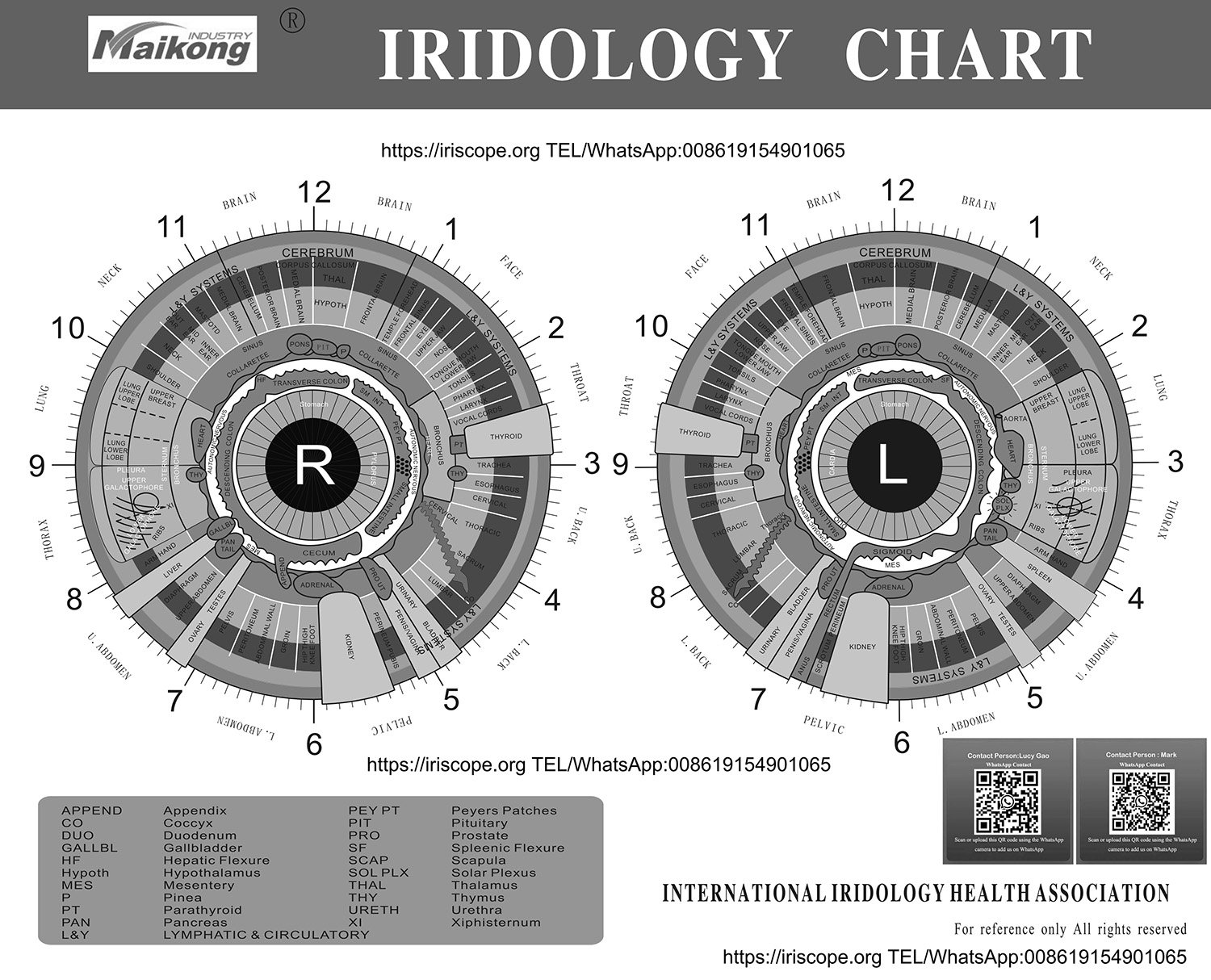
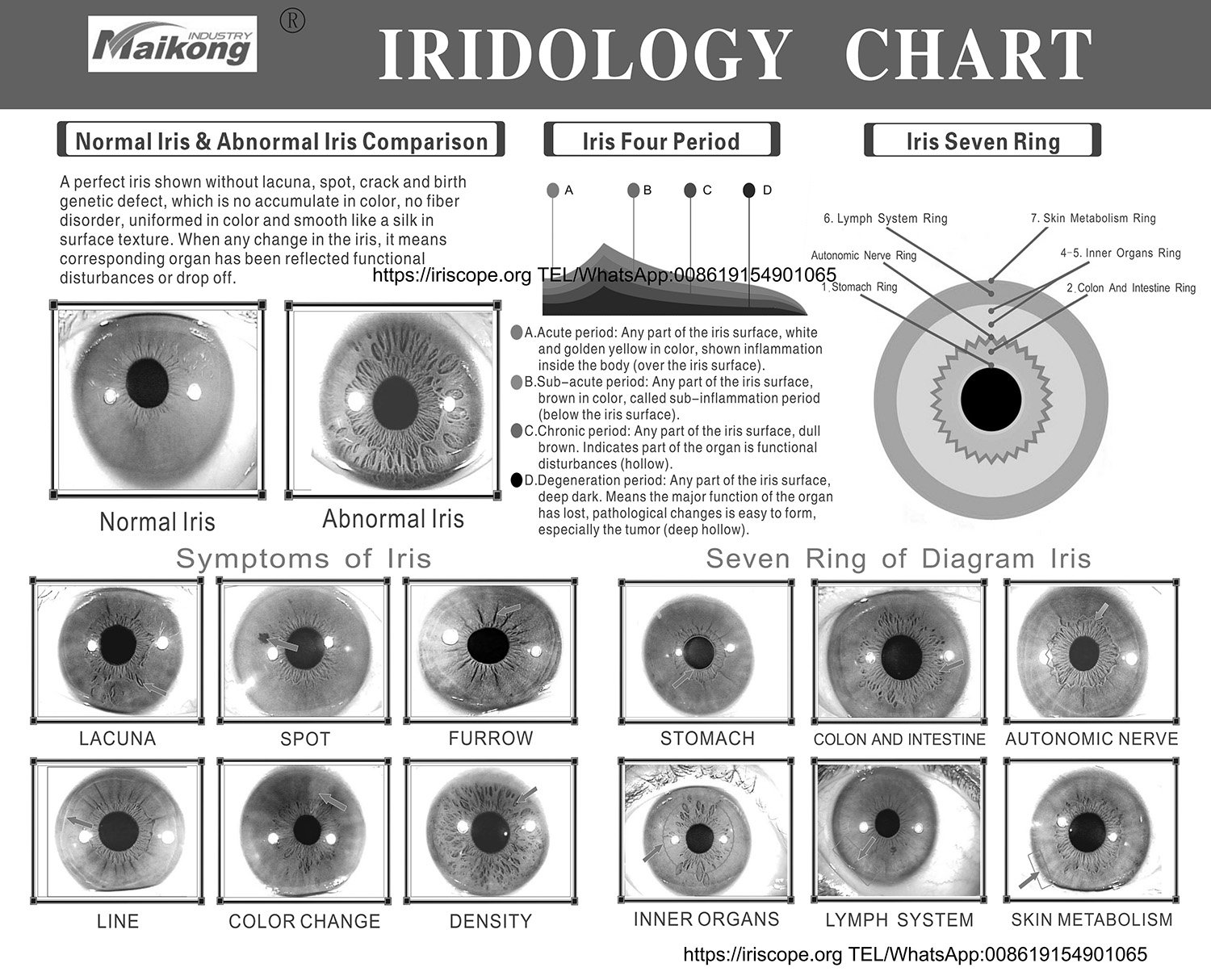
Selecting the optimal iridology chart high resolution resource requires considering several factors specific to your professional situation. Let me guide you through a systematic selection process.
Define Your Primary Use Case
Start by clarifying how you will primarily use the chart. Different applications demand different chart characteristics:
- Clinical Wall Display: Requires large format printable version, minimum 24×36 inches, simple enough for clients to understand at a glance
- Software Integration: Needs PNG format with transparency support, precise zone boundaries for overlay accuracy
- Educational Handouts: Requires clear reproduction at letter size, detailed labeling for independent study
- Digital Presentations: Needs very high resolution for large screen display, modern visual design
- Equipment Demonstrations: Requires compatibility with your specific camera and software systems
Your primary use case determines the minimum acceptable resolution and optimal file format. A chart intended for software overlay needs different characteristics than a chart for printed handouts.
Determine Required Resolution Specifications
Calculate the minimum resolution based on your intended display size and viewing distance. Use this formula:
Minimum pixels = (Display width in inches × Desired DPI) × (Display height in inches × Desired DPI)
For professional print quality, use 300 DPI. For digital displays, calculate based on screen pixel density. A 24×36 inch printed chart at 300 DPI requires a minimum 7200×10800 pixel source image.
I always recommend obtaining the highest resolution version available, even if it exceeds your current needs. Higher resolution provides flexibility for future applications and ensures optimal quality when technology improves.
Evaluate Chart Style and Traditional System
Different traditional iridology systems use different zone arrangements. Verify that your chosen chart aligns with the traditional system you practice or teach. Common options include:
- Bernard Jensen System: Most widely taught in North America, clear organ zone organization
- European Zone Systems: Often more detailed, multiple sub-zone divisions
- Russian/Slavic Systems: Unique zone arrangements, popular in Eastern Europe
- Modern Integrated Systems: Combine elements from multiple traditional approaches
Consistency matters in professional practice. Using charts that align with your training and the literature you reference creates coherence in your work and communication.
Assess Language and Localization Needs
If you serve clients who speak languages other than English, prioritize charts available in relevant languages. Multilingual capability enhances client understanding and demonstrates cultural sensitivity.
Our MAIKONG chart library includes versions in 17 languages. This extensive language support allows you to serve diverse populations without compromising educational quality. Clients appreciate seeing technical information presented in their native language.
Consider Source Reliability and Support
Obtain charts from established sources that provide ongoing support and updates. Reputable iridology camera manufacturers and training institutions typically offer reliable chart resources.
Support matters when you encounter technical issues or need customization. A manufacturer that provides responsive assistance helps you resolve problems quickly. Free charts from unknown sources offer no support path when issues arise.
Test Compatibility with Your Existing Systems
Before committing to a chart resource, test its compatibility with your existing equipment and software. Load the chart into your iridology software. Attempt to overlay it on a sample iris photograph. Verify that transparency works correctly and that zone alignment matches your camera’s iris image orientation.
Compatibility testing prevents frustrating surprises after you have invested time and resources. A chart that looks perfect as a standalone image might not function properly when integrated into your workflow.
Complete Iridology Solutions: Equipment + High-Resolution Charts
MAIKONG offers integrated iridology systems that combine professional cameras, advanced software, and high-resolution chart resources. Our packages include everything you need to begin professional iris observation immediately. All charts are included in multiple languages and formats optimized for our equipment.
Digital Versus Printed Iridology Chart High Resolution Formats
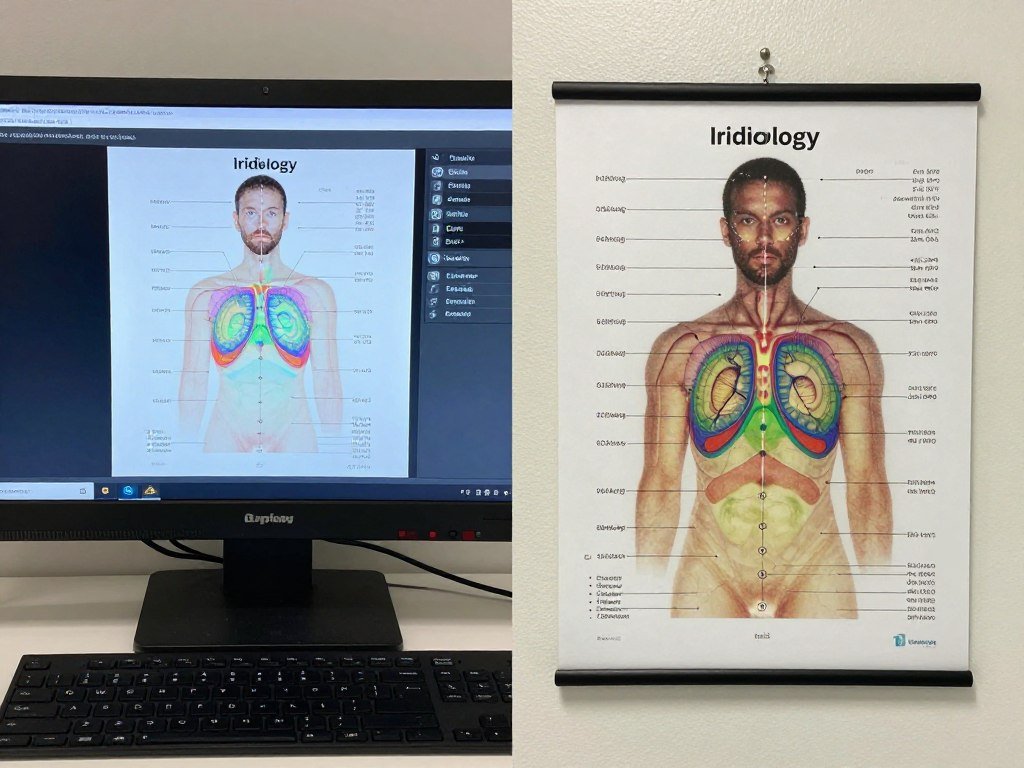
Both digital and printed iridology chart high resolution formats serve important roles in professional practice. Understanding the advantages and limitations of each format helps you determine the optimal combination for your needs.
Digital Format Advantages
Digital charts offer remarkable flexibility. You can instantly switch between chart styles, zoom into specific zones for detailed study, and overlay charts onto iris photographs with precision. File management allows you to organize multiple chart versions and access them instantly during client sessions.
Digital formats support the transparent iridology chart overlay function that has become essential in modern practice. You capture an iris image with your iridology camera, load it into software, and immediately apply a chart overlay. The transparency allows you to see both the iris features and the zone boundaries simultaneously.
Storage and sharing also favor digital formats. You can store hundreds of chart variations without physical space requirements. You can email chart files to students or colleagues instantly. You can display digital charts on tablets during mobile consultations or home visits.
Version control becomes simpler with digital files. When updated charts become available, you simply replace the old file. All your future work uses the updated version without any physical inventory to discard.
Printed Format Advantages
Despite digital advantages, printed charts maintain important roles in professional settings. A large, professionally printed iridology chart large format on a consultation room wall creates immediate visual impact. It communicates professionalism and specialization before you say a word.
Printed charts require no technology to view. They remain accessible during power outages, computer malfunctions, or technical difficulties. They provide a reliable backup reference that never depends on software compatibility or file format issues.
Many clients respond better to physical printed materials. A tangible chart feels more authoritative than a screen image to some people. The permanent, unchanging nature of a printed chart may inspire more confidence than digital files that can be easily modified.
Printed charts also support specific educational activities. Students can annotate printable study copies, highlight zones during learning, and create personalized reference materials. These active learning techniques work better with physical paper than digital screens for many learners.
Optimal Format Combinations
I recommend maintaining both digital and printed chart resources. Use digital formats for software integration, client photograph overlays, and presentation flexibility. Use printed formats for wall displays, student handouts, and backup reference.
A typical professional setup might include a large printed chart on the consultation room wall, digital chart files integrated into the iridology software, and printed handout versions for client education. This combination provides maximum flexibility across all practice situations.
Print Quality Considerations
When creating printed versions from digital files, maintain quality through proper printing specifications. Use professional printing services for large-format displays. Specify minimum 300 DPI resolution. Select appropriate paper stock that resists fading and maintains color accuracy.
I have seen practitioners disappointed with self-printed charts using consumer inkjet printers. The quality rarely matches professional printing, especially at large sizes. Colors shift, text appears fuzzy, and the overall impression undermines rather than enhances professional credibility.
For printable chart resources, I recommend professional printing for sizes above 11×17 inches. Below that size, quality office printers can produce acceptable results if you use high-grade paper and verify proper resolution.
Legal and Ethical Considerations for Iridology Chart Usage

Using iridology chart high resolution resources in professional practice involves important legal and ethical responsibilities. Understanding these considerations protects both you and your clients.
Medical Disclaimer Requirements
Traditional iridology observation does not constitute medical diagnosis. You must clearly communicate this distinction to clients and in all materials. Charts should include disclaimers stating they represent traditional zone mapping for educational purposes, not medical diagnostic tools.
I always include clear disclaimer language when providing charts to practitioners and institutions. The disclaimer typically states: “This chart represents traditional iridology zone mapping for educational and observational purposes. It is not a medical diagnostic tool. Iridology observations do not diagnose, treat, or cure medical conditions. Always consult qualified healthcare providers for medical diagnosis and treatment.”
This language protects you legally and sets appropriate client expectations. Clients understand they are receiving traditional observational analysis, not medical diagnosis.
Copyright and Usage Rights
Chart images typically carry copyright protection. Verify that you have appropriate rights to use, reproduce, and distribute any charts you incorporate into your practice. Free charts from unknown sources may involve copyright violations that expose you to legal liability.
When you purchase charts or equipment packages that include charts, the licensing terms specify your usage rights. Some licenses permit personal use only. Others allow professional practice use. Some permit reproduction for educational purposes within your own practice or school.
Our MAIKONG equipment packages include chart usage rights that permit professional practice application. You can use the provided charts in client consultations, print them for wall display, and incorporate them into client reports. You cannot redistribute the chart files or use them in competing commercial products without separate licensing.
Scope of Practice Boundaries
Use charts within your professional scope of practice. If you are not a licensed medical provider, avoid language that implies medical diagnosis or treatment. Focus on educational observation, traditional zone reference, and wellness support rather than disease diagnosis.
This scope awareness influences how you present chart information to clients. Instead of stating “this zone shows liver disease,” you might say “traditional iridology associates this zone with liver function, and I observe variations here that you may want to discuss with your healthcare provider.”
The subtle language difference maintains ethical boundaries while still providing valuable observational information. Clients receive insights that support their health awareness without crossing into unauthorized medical practice.
Client Education and Informed Consent
Educate clients about what iridology charts represent and how you use them. Explain that zones represent traditional correlations developed through historical observation, not scientifically validated diagnostic regions. Ensure clients understand the educational and observational nature of the process.
I recommend providing written information about iridology methodology and limitations. This transparency builds trust and ensures clients make informed decisions about receiving iris observations. It also creates documentation that you provided appropriate education about the service’s nature and limitations.
Future Developments in Iridology Chart Technology
Technology continues to enhance how we create, distribute, and use iridology chart high resolution resources. Understanding emerging trends helps you prepare for future developments in professional practice.
Interactive Digital Charts
Next-generation iridology software incorporates interactive chart features. Instead of static images, these charts allow you to click on zones to see detailed information, view related health indicators, and access educational resources about specific areas.
I am currently developing enhanced interactive features for our MAIKONG software. Future versions will allow practitioners to customize zone information, add personal notes to specific chart areas, and link zones to product recommendations or educational content.
Interactive charts also support better client education. You can click through zone layers, showing progressively more detailed information as client understanding develops. This progressive disclosure prevents overwhelming clients while providing depth for those who want more detailed information.
Artificial Intelligence Integration
Artificial intelligence technologies are beginning to assist with iris zone analysis. AI systems can automatically identify iris features and correlate them to chart zones. While these systems cannot replace professional judgment, they assist with documentation and pattern recognition.
Our MAIKONG software includes AI-assisted analysis features that suggest which zones show variations based on automated image analysis. The system highlights areas that may warrant closer attention, streamlining the observation process.
Future AI developments may include automatic chart overlay alignment, intelligent zone marking suggestions, and pattern matching against large databases of iris images. These capabilities will enhance, not replace, professional expertise in traditional iridology observation.
Augmented Reality Chart Overlays
Augmented reality (AR) technology may soon allow real-time chart overlays during live iris observation. Instead of capturing a photograph first, practitioners could view chart zones superimposed directly onto the live iris view through specialized eyewear or display systems.
While this technology remains in early development for iridology applications, the potential benefits are significant. Real-time overlay eliminates the delay between observation and chart reference. It creates a more dynamic, interactive observation process.
Cloud-Based Chart Libraries
Cloud storage and distribution systems make comprehensive chart libraries accessible from any device. Instead of maintaining local chart files, practitioners access centralized libraries that automatically update when new chart versions become available.
Our MAIKONG software roadmap includes cloud-based chart library features. Practitioners will be able to access charts in any supported language, switch between chart styles instantly, and receive automatic updates when improved versions are released. This cloud approach ensures you always have access to the most current, highest-quality chart resources.
Personalized Chart Customization
Advanced software will increasingly support practitioner-specific chart customization. You will be able to modify zone boundaries based on your preferred traditional system, add personal annotations, integrate your own observational categories, and create entirely custom chart variations.
This personalization reflects the reality that traditional iridology encompasses multiple schools of thought and interpretive approaches. Rather than forcing all practitioners into a single chart system, future technology will accommodate diverse approaches while maintaining core zone mapping principles.
Buying Guide: Iridology Chart High Resolution Resources and Equipment Packages
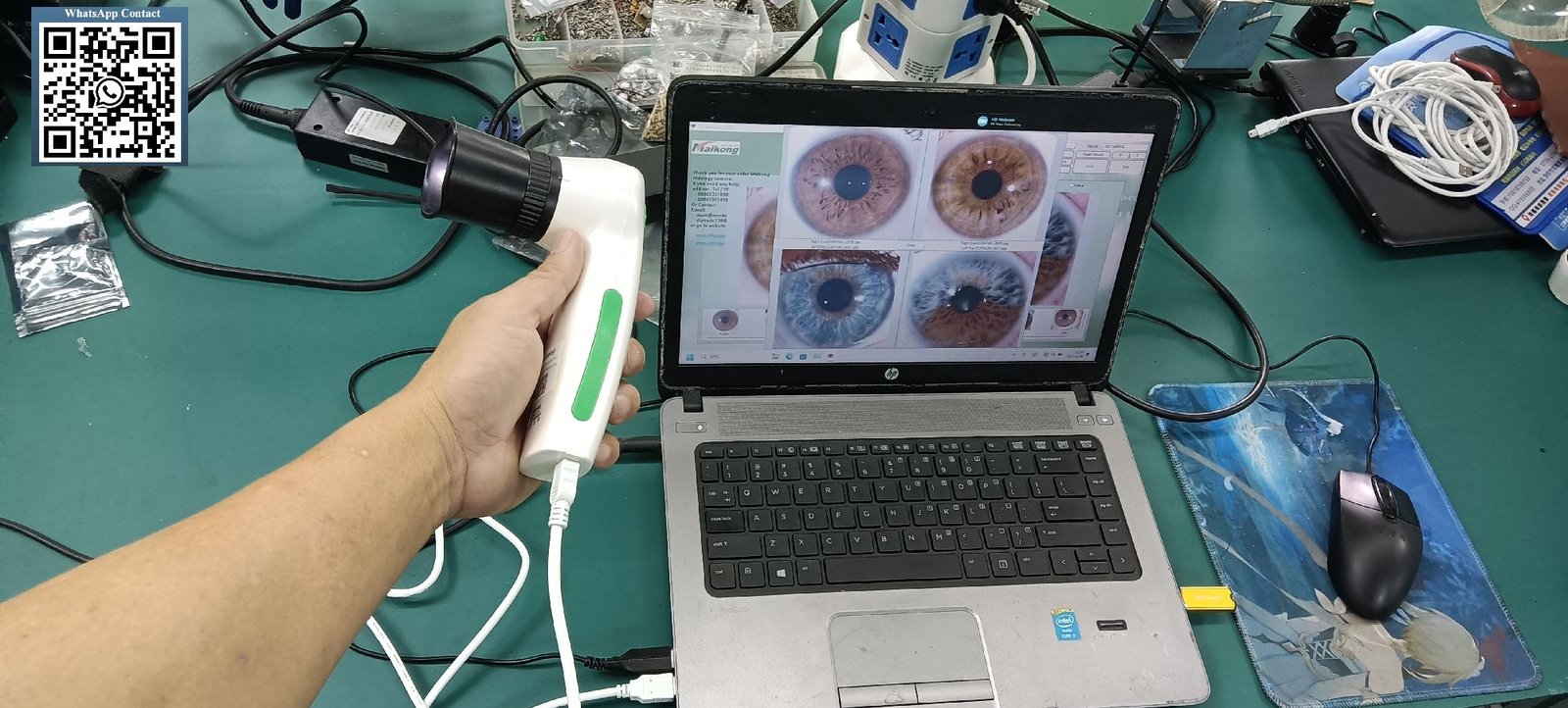
Purchasing decisions for iridology chart high resolution resources and related equipment benefit from understanding the complete market landscape and value considerations.
Standalone Chart Purchase Considerations
If you need only chart resources without equipment, evaluate several factors:
- Resolution specifications: Confirm actual pixel dimensions for your intended use
- File format: Verify compatibility with your existing software (PNG, JPEG, PDF, vector formats)
- Usage rights: Understand licensing terms for professional use, reproduction, distribution
- Chart style: Ensure alignment with your preferred traditional zone system
- Language availability: Confirm charts are available in languages relevant to your client base
- Customization options: Determine whether branding or modifications are possible
- Support availability: Verify that technical assistance is available if needed
- Update policy: Understand whether future updates are included or require additional purchase
Standalone chart pricing varies widely. Free charts from educational sources may serve basic needs but typically lack support, customization, and guaranteed accuracy. Professional chart packages from equipment manufacturers or training institutions typically range from basic free versions to premium customized versions at moderate cost.
Integrated Equipment Package Advantages
Purchasing complete systems that include charts, cameras, and software offers several advantages over piecemeal acquisition. Integrated packages ensure compatibility across all components. You avoid the frustration of discovering that your chart files don’t work properly with your camera software.
Our MAIKONG equipment packages include comprehensive chart resources as standard components. When you purchase an iriscope system, you receive high-resolution charts in all 17 supported languages, both digital and printable versions, and charts optimized for our software’s overlay functions.
The package approach also simplifies your purchasing decision. Instead of researching separate components from different vendors, you make one decision and receive everything needed for complete iris observation capability.
Evaluating Equipment Manufacturer Chart Quality
Not all equipment manufacturers provide equal chart quality. Evaluate chart resources as carefully as you evaluate camera specifications. Request sample chart files before purchasing. Check resolution, accuracy, and visual clarity.
I encourage potential customers to compare our MAIKONG chart resources with alternatives. We are confident that our charts match or exceed competitive offerings in resolution, accuracy, visual design, and language availability. This confidence comes from 20 years of refinement based on practitioner feedback.
Total Cost of Ownership Considerations
Look beyond initial purchase price to total cost of ownership. A seemingly inexpensive chart might require future purchases for updates, additional languages, or customization. A more complete initial package might cost more upfront but deliver better long-term value.
Consider also the cost of your time. Searching for free charts, troubleshooting compatibility issues, and assembling piecemeal solutions consumes valuable professional time. A well-integrated package from a single manufacturer eliminates these time costs.
Support and Training Value
Technical support and training resources add significant value to chart and equipment purchases. When you encounter questions about chart usage, overlay alignment, or integration issues, responsive support resolves problems quickly.
Our MAIKONG support includes technical assistance with chart integration, customization guidance, and training resources that help you maximize the value of your chart resources. This support is included with equipment purchases and available to all our professional customers.
| Component | Specification | Quantity |
| Iridology Camera Handset | 12MP CCD with LED illumination | 1 unit |
| 30X Iris Lens | Imported multi-coated optics | 1 unit |
| Protective Lens Cover | Dust and scratch protection | 1 unit |
| USB Connection Cable | 1.5 meter high-speed USB | 1 cable |
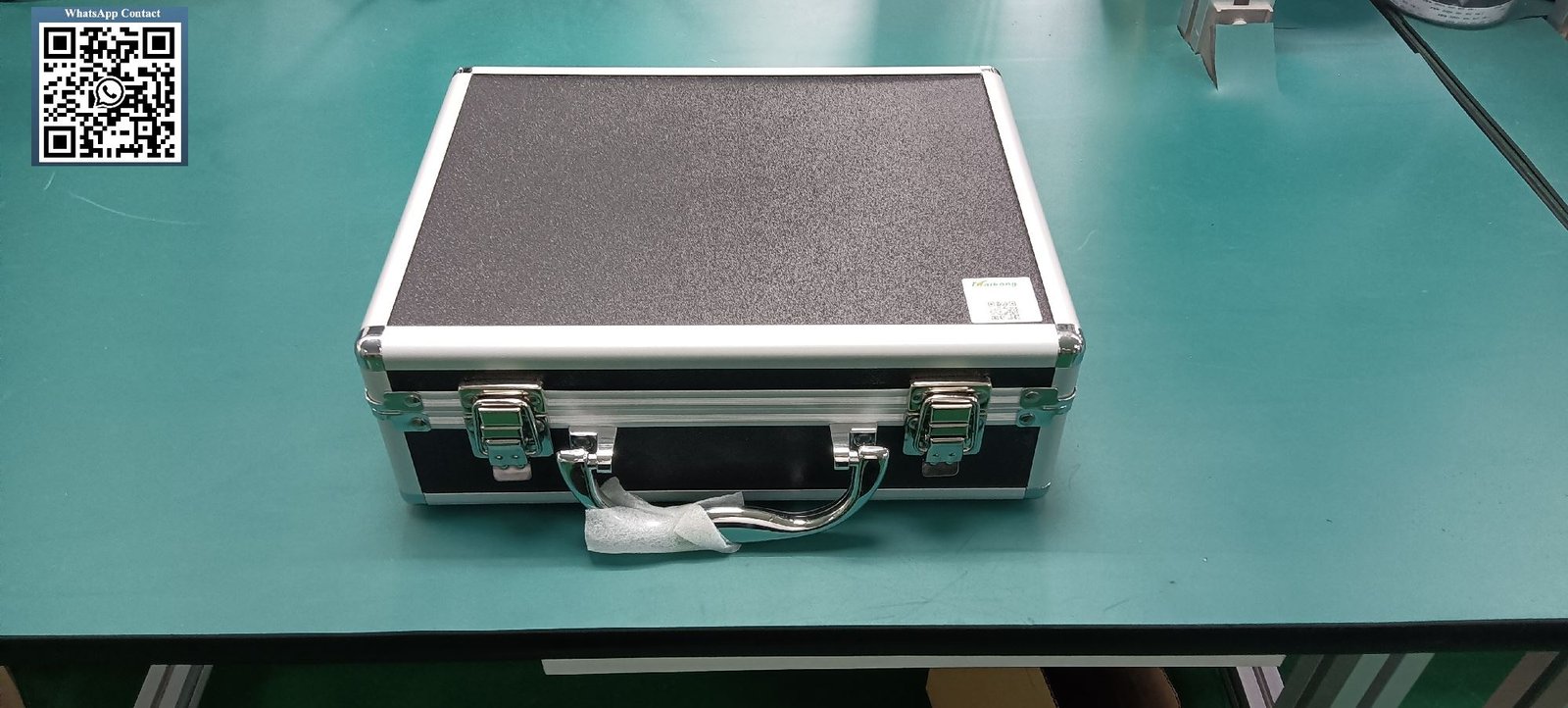
| Leather Storage Case | PU leather protective case | 1 case |
| Software Installation Media | USB drive with drivers and software | 1 drive |
| High-Resolution Chart Collection | Digital files, 17 languages | Complete set |
| Printed Reference Chart | Professional printed poster | 1 poster |
| User Manual | Comprehensive instructions | 1 manual |
| Warranty Documentation | 13-month warranty certificate | 1 certificate |
Partnership Opportunities for US Distributors and Resellers

The US market for iridology equipment and iridology chart high resolution resources continues to grow. Natural health practitioners, wellness centers, chiropractic offices, and training institutions increasingly incorporate iris observation into their services. This growth creates opportunities for distributors and resellers.
Market Opportunity in the United States
The US natural health market values traditional wellness approaches. Iridology appeals to practitioners seeking non-invasive observation tools that complement holistic health philosophies. The market includes several key segments:
- Natural health practitioners: Iridologists, naturopaths, wellness consultants
- Complementary therapy clinics: Chiropractic offices, acupuncture clinics, massage therapy centers
- Training institutions: Iridology schools, natural health colleges, continuing education providers
- Health product retailers: Wellness stores, natural health product distributors
- Direct sales organizations: Health product MLM companies, wellness product brands
- Spa and wellness centers: High-end spas offering advanced wellness services
Each segment represents distinct opportunities. Practitioners need individual equipment units. Training institutions need multiple systems plus educational charts. Retailers need products they can resell to their client base.
Advantages of MAIKONG Partnership
As a direct manufacturer based in SZ, GD, China, MAIKONG offers distributor advantages that middleman suppliers cannot match:
- Manufacturer direct pricing: No middleman markup, better margins for distributors
- Customization capabilities: OEM/ODM options for branded products
- Comprehensive product line: Cameras, software, charts, accessories – complete solutions
- Quality certifications: CE and ISO9000 certified manufacturing
- 20+ years experience: Proven track record with 1000+ OEM clients worldwide
- Multi-language support: 17 languages enable diverse market service
- Dual OS compatibility: Windows and macOS support (industry first)
- US warehouse availability: Inventory in the United States for faster delivery
- Technical support: Comprehensive training and ongoing assistance
- Marketing resources: Charts, images, specifications for distributor use
Distributor Support Programs
We provide extensive support to help distributors succeed in their markets. This support includes product training on equipment operation and software features. We provide sales training covering market positioning, target customer identification, and effective demonstration techniques.
Marketing support includes high-resolution product images, technical specifications, and demonstration scripts. We assist with developing marketing materials customized for your target market. For larger distributor partnerships, we offer co-branded materials featuring both MAIKONG and your company branding.
Technical support extends to your customers. When your clients encounter questions or issues, our support team assists with resolution. This backend support allows you to confidently sell technical products without requiring extensive in-house technical expertise.
OEM and Private Labeling Opportunities
For distributors wanting to build their own brand, we offer comprehensive OEM/ODM services. You can specify custom hardware colors, modify equipment styling, and create private-labeled products. Software customization allows your logo, branding, and company information throughout the user interface.
Chart customization extends to include your branding on all chart resources. Your customers receive charts featuring your company name and logo, reinforcing your brand identity. This complete branding creates a professional, cohesive product line under your own label.
We have successfully completed OEM projects for distributors worldwide. Our experience ensures smooth execution of custom projects from design through production and delivery. We understand distributor needs and work to create solutions that support your market success.
Getting Started as a MAIKONG Distributor
Beginning a distributor relationship starts with understanding your market and goals. We discuss your target customer segments, your geographic coverage area, your sales channels, and your volume projections. This information helps us structure a partnership that aligns with your business model.
Initial orders can start at modest levels while you develop your market. As your volume grows, pricing improves and additional support becomes available. We view distributor relationships as long-term partnerships, not transactional one-time sales.
Sample equipment is available for evaluation. You can test our systems, evaluate chart quality, and assess software functionality before committing to inventory purchases. This hands-on evaluation gives you confidence in the products you will represent.
Become a MAIKONG US Distributor or Reseller Partner
MAIKONG seeks qualified distributors and resellers in the United States to expand our market presence. We offer manufacturer direct pricing, comprehensive support, OEM/ODM customization, and a complete product line including high-resolution iridology charts, professional cameras, and advanced software. Whether you serve natural health practitioners, training institutions, or wellness retailers, we can structure a partnership that supports your business goals.
Contact Lucy at MAIKONG to discuss distributor opportunities, pricing, and partnership terms.
Frequently Asked Questions About Iridology Chart High Resolution

What resolution do I need for an iridology chart high resolution for professional printing?
For professional printing, you need a minimum of 300 DPI (dots per inch) at your final print size. For a standard 24×36 inch wall chart, this requires a source image of at least 7200×10800 pixels. Larger prints require proportionally higher resolution. I recommend always obtaining the highest resolution version available to maintain quality at any print size and to future-proof your resource.
Can I use a transparent iridology chart with any iris photography software?
Transparent chart overlays require software that supports PNG format with alpha channel transparency. Not all iris photography programs include overlay functionality. Basic photo viewers may display the transparent chart but won’t allow precise alignment with iris photographs. Professional iridology software designed for clinical use includes specific overlay functions with alignment controls. Our MAIKONG software supports transparent chart overlays with precise positioning, rotation, and opacity adjustment for optimal integration with iris photographs.
What is the difference between left eye and right eye iridology chart high resolution versions?
Traditional iridology systems map different body zones to the left and right irises. The left eye chart shows zones traditionally associated with the left side of the body, while the right eye chart shows right-side zones. Some organs appear on both charts while others appear only on one side. For example, the heart zone typically appears on the left iris chart, while the liver zone appears on the right iris chart. Professional practice requires both charts for complete reference, as you observe both irises during consultations.
How do I verify that an iridology chart image is truly high resolution before downloading?
Check the actual pixel dimensions of the file, not just file size. Right-click the image file (or use your system’s file properties) to view image information. Look for pixel width and height specifications. For professional use, I recommend minimum 3000 pixels on the shortest side. Be cautious of files described as “high resolution” without specific pixel dimensions provided. Reputable sources always specify exact pixel dimensions. You can also test a small section by zooming to 200-300% and checking whether text remains sharp and zone boundaries stay clearly defined.
Are iridology chart high resolution files compatible with both Windows and Mac computers?
Standard image formats like PNG and JPEG work on all operating systems. The chart file itself is platform-independent. However, the software you use to view and work with charts may be platform-specific. Our MAIKONG iridology software supports both Windows (XP through 11, 32-bit and 64-bit) and macOS (versions 10.14 through current releases). This dual-platform support is industry-leading, as many iridology software packages only support Windows. When selecting chart resources, verify that any included software runs on your preferred operating system.
Can I customize an iridology chart high resolution with my practice branding?
Customization availability depends on your chart source and usage rights. Free charts typically do not permit modification. Professional chart packages from equipment manufacturers often include customization options as part of distributor programs or for bulk purchases. At MAIKONG, we offer chart customization services including adding your practice name, logo, and contact information. We can also modify chart layouts, add zones, change color schemes, and create completely custom chart designs. Customization works best when planned as part of an equipment package or distributor partnership, as it involves professional design work to maintain quality and accuracy.
What file format is best for iridology chart high resolution images?
PNG format offers the best combination of quality and versatility for iridology charts. PNG supports transparency (essential for overlay functions), maintains quality without compression artifacts, and works across all platforms and software. For printed charts, PDF format works well as it preserves resolution and color accuracy. JPEG can work for basic viewing but introduces compression that may blur fine details. Vector formats like SVG offer unlimited scaling but most traditional iridology charts exist as raster images. I recommend obtaining charts in PNG format as your primary resource, with PDF versions for printing large formats.
How often should I update my iridology chart high resolution resources?
Traditional iridology zone systems remain relatively stable, but refinements and new interpretations do emerge. I recommend reviewing your chart resources every 2-3 years to see if updated versions or improved formats have become available. When you upgrade equipment or software, verify that your chart resources remain compatible with new systems. Some practitioners maintain multiple chart versions representing different traditional schools of thought. This diversity allows you to reference various interpretive approaches and to accommodate different training backgrounds among colleagues or students.
Can I use the same iridology chart high resolution file for both digital display and printing?
Yes, if the resolution is sufficiently high. A single high-resolution file can serve both purposes, but you need adequate pixel dimensions for your largest intended use. If you plan to print at 24×36 inches, the source file must contain enough pixels for that size at 300 DPI (approximately 7200×10800 pixels). That same file will work perfectly for digital display on any screen. However, a file optimized only for screen display (such as 1920×1080 pixels) will look pixelated when printed at large sizes. Always obtain the highest resolution available to maximize versatility across all applications.
What languages are available for iridology chart high resolution resources?
Language availability varies by source. Basic free charts typically exist only in English. Professional chart resources from international manufacturers offer multiple language versions. Our MAIKONG chart library includes 17 languages: English, Spanish, French, German, Italian, Portuguese, Russian, Polish, Czech, Bulgarian, Japanese, Korean, Malaysian, Persian, Simplified Chinese, Traditional Chinese, and Japanese. This extensive language support allows you to serve diverse client populations and enables international distributors to serve their local markets. All language versions maintain the same high resolution and technical accuracy, with only the text labels translated.
Conclusion: Selecting and Using Professional Iridology Chart High Resolution Resources

Throughout this guide, I have shared insights from two decades of experience manufacturing iridology equipment and working with practitioners worldwide. The iridology chart high resolution resource you select significantly impacts your professional practice, your client education effectiveness, and your overall credibility in the field.
High-resolution charts serve multiple critical functions. They provide accurate reference for zone identification during iris observation. They enhance client education by visually demonstrating traditional zone concepts. They support training and continuing education efforts. They contribute to the professional appearance of your practice or clinic.
When selecting charts, prioritize genuine high resolution with confirmed pixel dimensions. Verify compatibility with your existing equipment and software, or consider integrated systems where all components work together seamlessly. Obtain charts that align with your preferred traditional zone system and your client language needs.
Remember that charts represent traditional iridology zone mapping for educational and observational purposes. They are not medical diagnostic tools. Use them within appropriate scope of practice boundaries, with proper disclaimers, and as part of a comprehensive approach to supporting client wellness awareness.
The integration of quality charts with professional iridology cameras and advanced software creates a powerful system for traditional iris observation. This complete approach delivers maximum value to your clients while establishing your practice as a professional, well-equipped resource in your community.
At MAIKONG, we remain committed to providing the highest quality iridology equipment, software, and chart resources to practitioners and institutions worldwide. Our 20 years of manufacturing experience, combined with feedback from over 1,000 professional clients, continuously refines our products to better serve your needs.
Whether you are an individual practitioner establishing a new practice, a training institution developing educational programs, or a distributor building a presence in the US market, we welcome the opportunity to discuss how our iridology chart high resolution resources and integrated equipment systems can support your goals.
Ready to Access Professional Iridology Chart Resources?
Contact our team to discuss your specific chart needs, equipment requirements, or distributor partnership opportunities. We provide personalized consultation to help you select the optimal solutions for your situation.
Email: Lucy@myiridology.us
WhatsApp: +86-135-1090-7401
Website: myiridology.us
Learn more about MAIKONG and our commitment to supporting the iridology professional community.
Thank you for taking the time to explore this comprehensive guide to iridology chart high resolution resources. I hope the information provided helps you make informed decisions that enhance your professional practice and better serve your clients’ wellness journeys.