
Jensen Iridology Chart: Your Complete Resource for Understanding Iris Zone Mapping
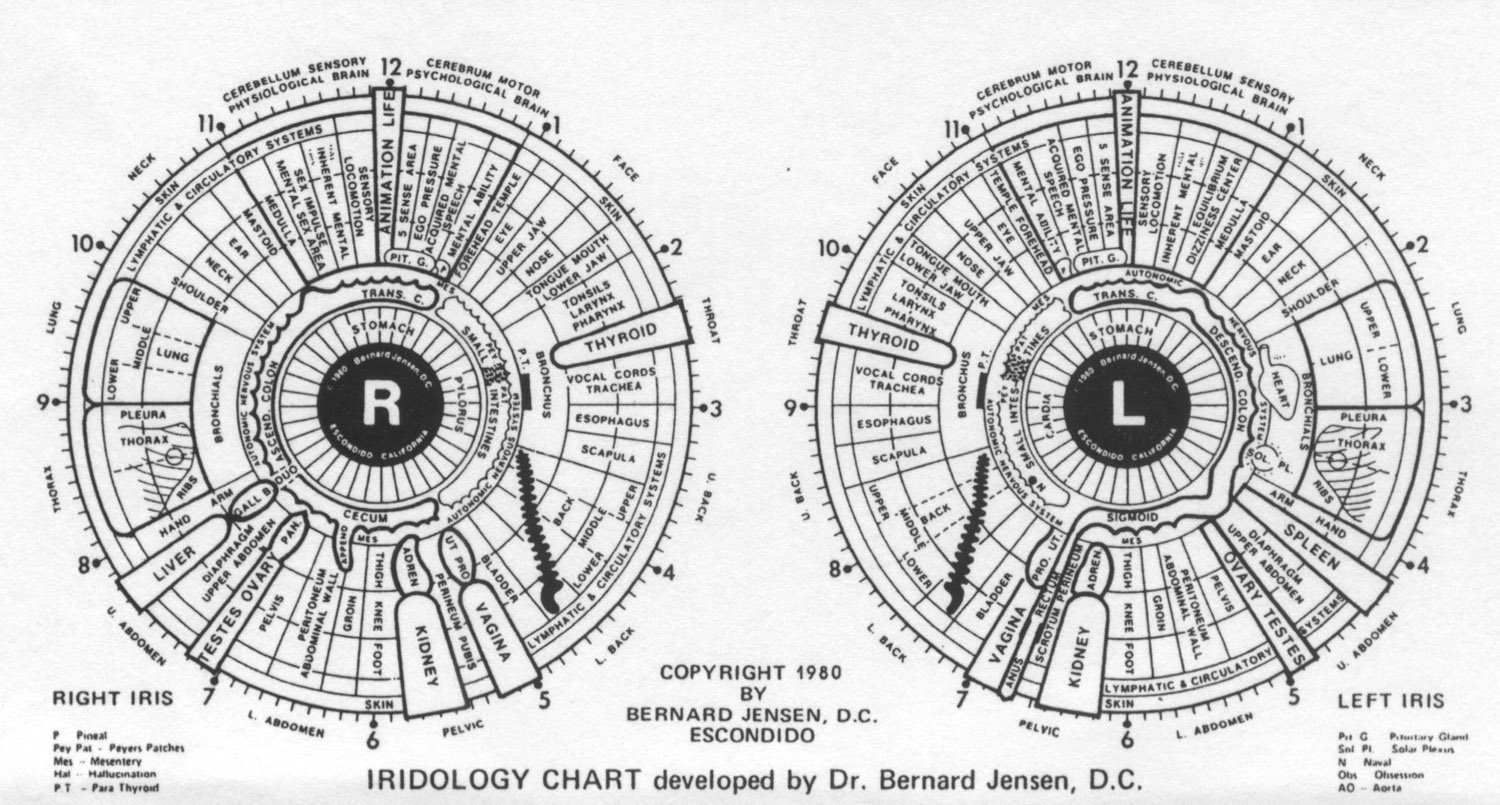
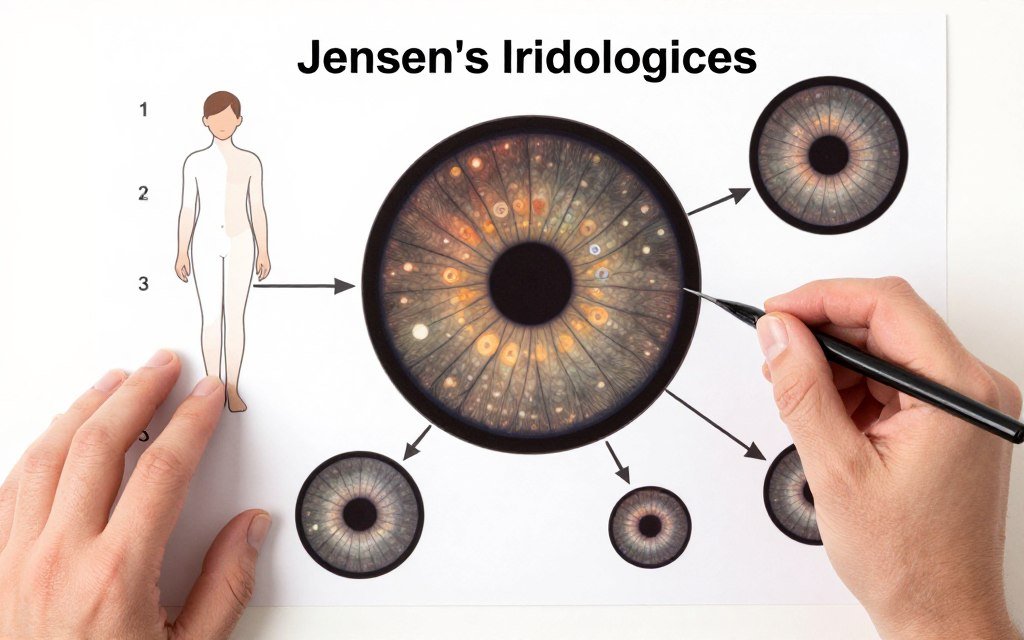
When practitioners search for a jensen iridology chart, they need more than just an image. They need a complete understanding of how Dr. Bernard Jensen mapped the human iris into specific zones that correspond to different body systems and organs. This traditional approach to iris observation has been used for decades as an educational tool in natural health practices.
I’ve worked with iridology practitioners across North America who rely on Jensen’s systematic zone mapping methodology. The chart developed by Dr. Jensen remains one of the most widely referenced iris mapping systems in traditional iridology education. Understanding this chart properly requires knowledge of zone divisions, left versus right eye differences, and practical reading techniques.
This guide answers every practical question about the jensen iridology chart. You’ll learn how zones are organized, what abbreviations mean, how to identify specific areas like the thyroid zone, and how modern iridology cameras and software display these traditional charts digitally for easier client consultations.
What Is the Jensen Iridology Chart and Why Practitioners Use It
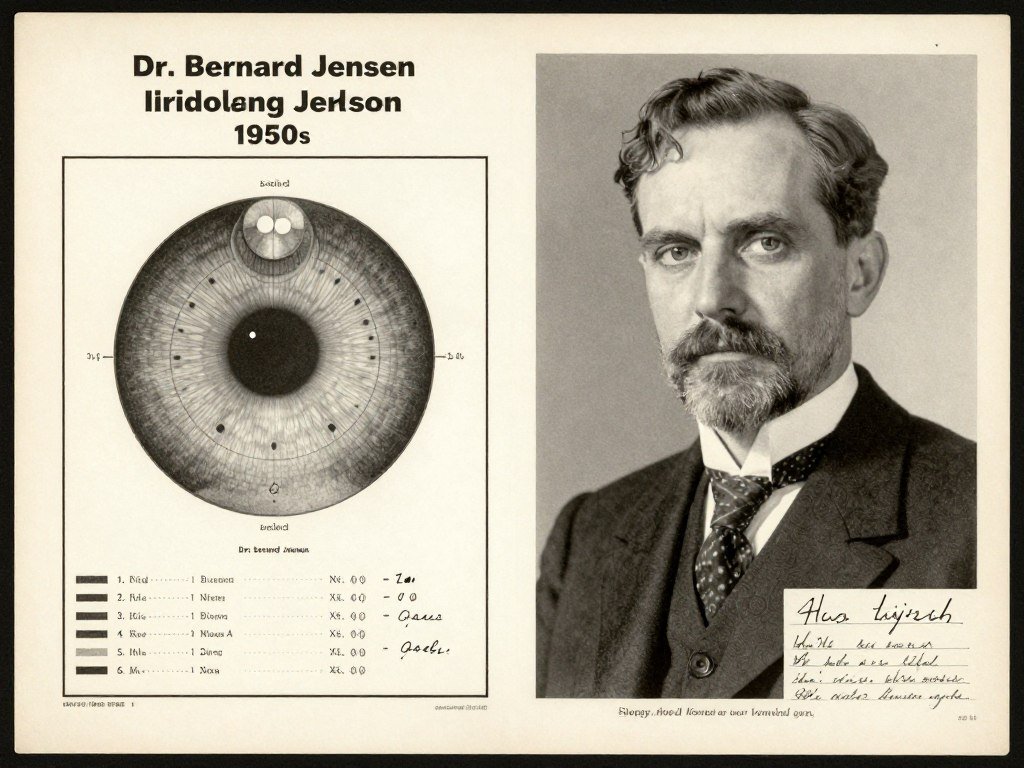
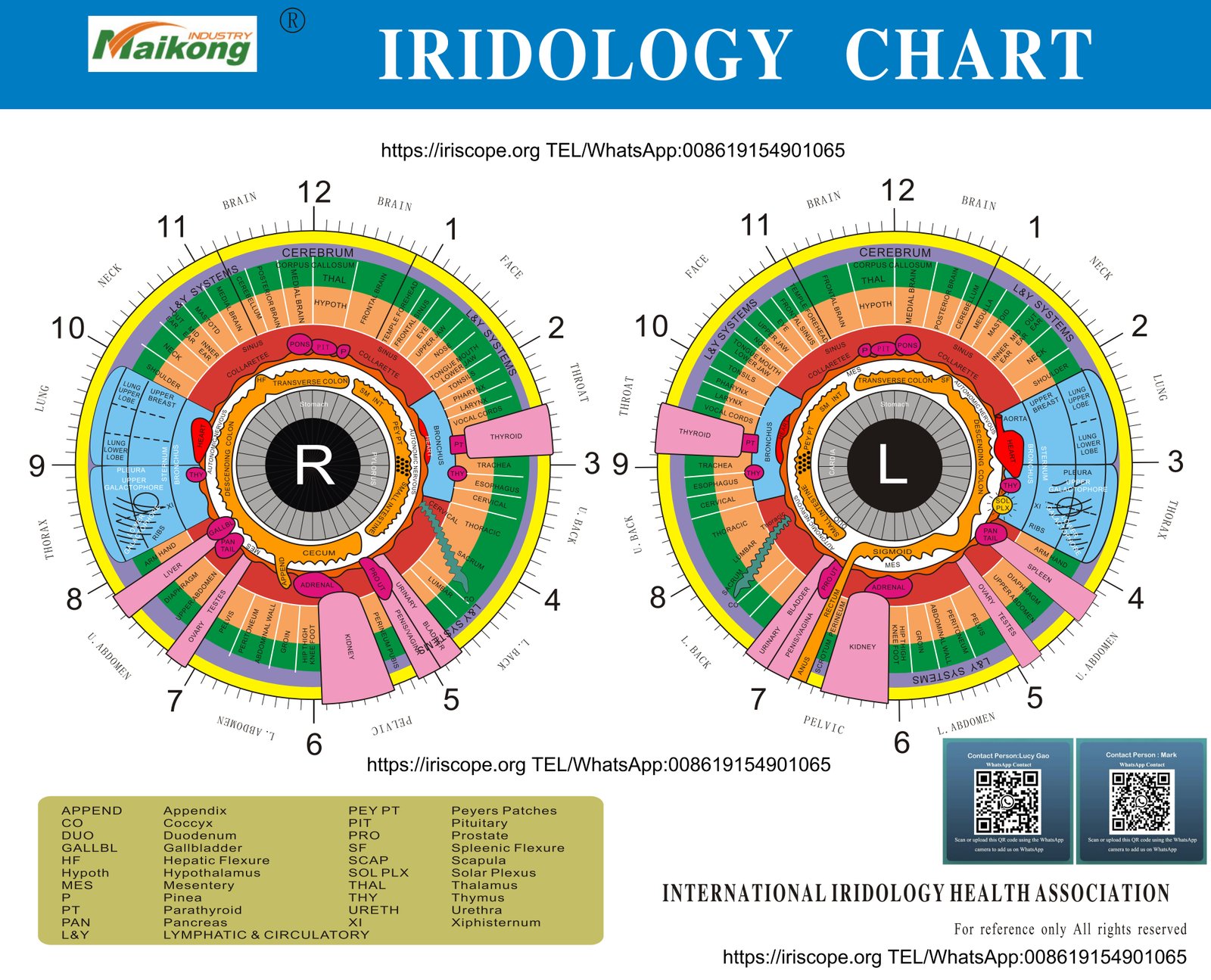
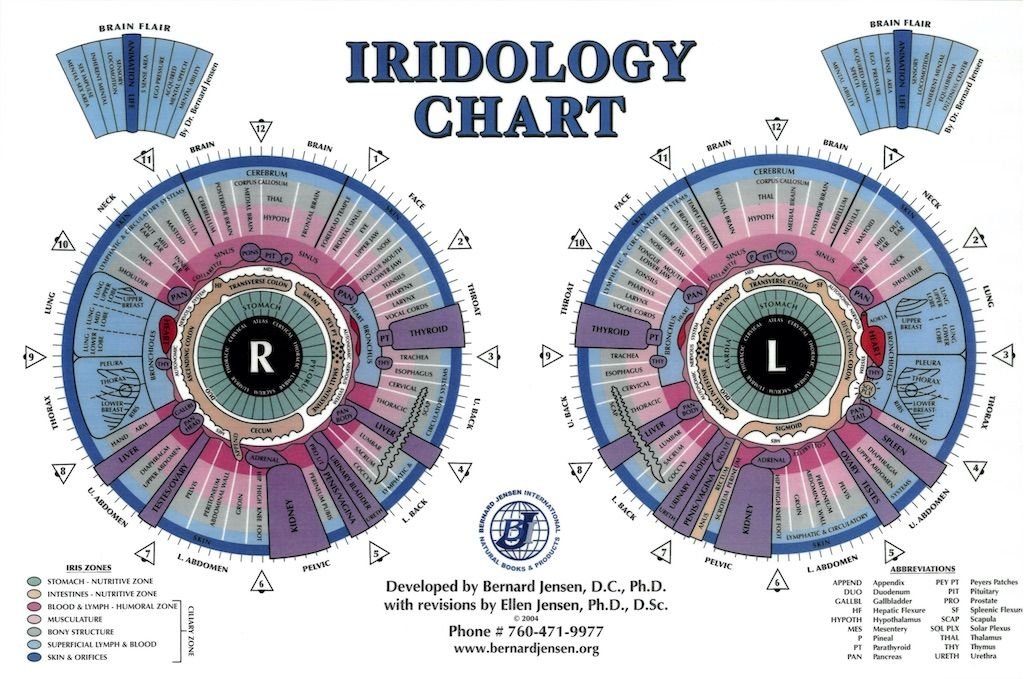
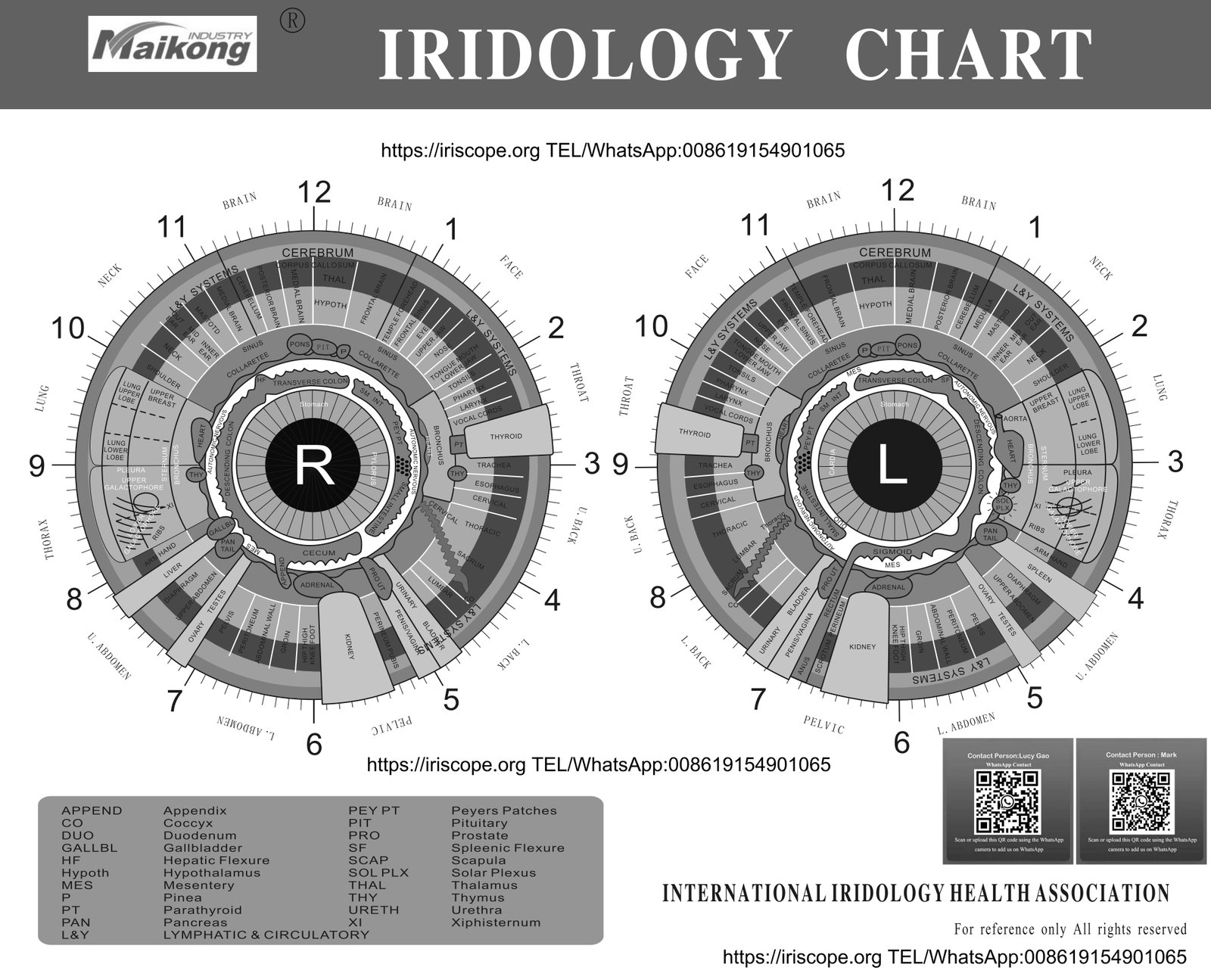
The iridology chart dr jensen created represents a systematic mapping of the iris divided into zones that traditional iridology associates with different body regions. Dr. Bernard Jensen, a pioneering chiropractor and nutritionist, developed this chart through decades of iris observations and documentation. His methodology divided each iris into approximately 80-90 distinct zones arranged in a circular pattern.
Practitioners value the iridology chart jensen developed because it provides a standardized reference framework. When examining iris images captured with an iridology camera, practitioners can reference Jensen’s zone divisions to identify areas of interest during traditional iridology observations.
The chart shows both left and right eyes with mirror-image zone arrangements. Unlike medical imaging, the jensen iridology chart serves purely as an educational reference tool for traditional iridology study. It helps practitioners organize their observations systematically rather than making medical diagnoses.
Left Eye Chart Features
The left eye iridology chart in Jensen’s system shows zones traditionally associated with the left side of the body. Organ zones appear in specific clock positions based on Jensen’s observational methodology.
- Heart zone positioned at approximately 2-3 o’clock
- Spleen area marked in the upper outer quadrant
- Descending colon path follows left side arc
- Adrenal gland zone near pupil margin at 3 o’clock
- Kidney zone placement in lower-mid region
Right Eye Chart Features
The iridology chart right eye displays mirror zones for right-side body regions. Jensen’s right eye mapping includes distinct placements for liver and gallbladder zones.
- Liver zone occupies significant area at 7-8 o’clock
- Gallbladder marked adjacent to liver region
- Ascending colon follows right side pathway
- Appendix zone positioned in lower right quadrant
- Thyroid zone appears in upper region near 12 o’clock
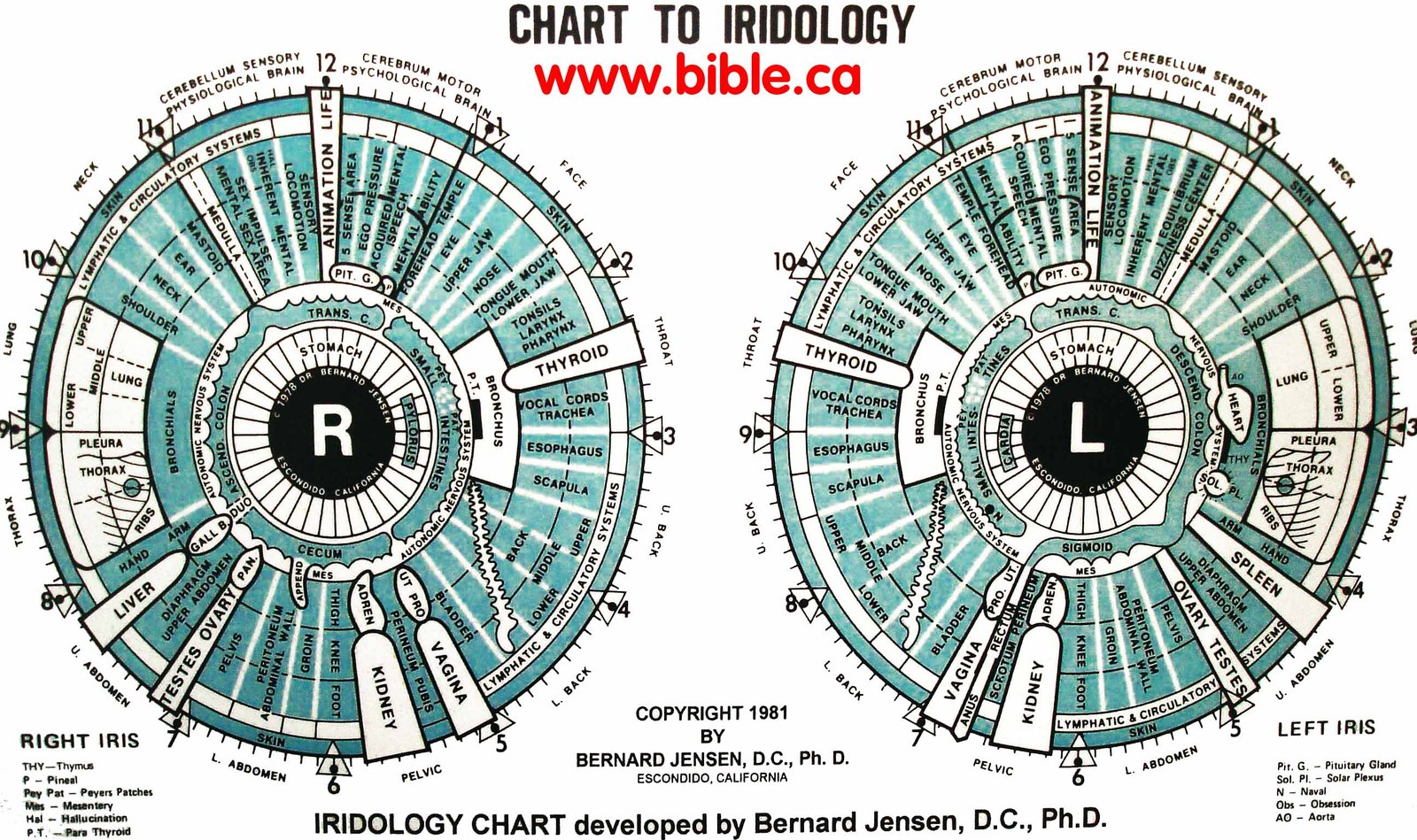
Modern iridology software systems display these traditional Jensen zones as digital overlays on captured iris images. This integration allows practitioners to reference zone locations while examining high-resolution iris photographs taken with professional equipment.
How Jensen Organized Iris Zones: The Circular Mapping System
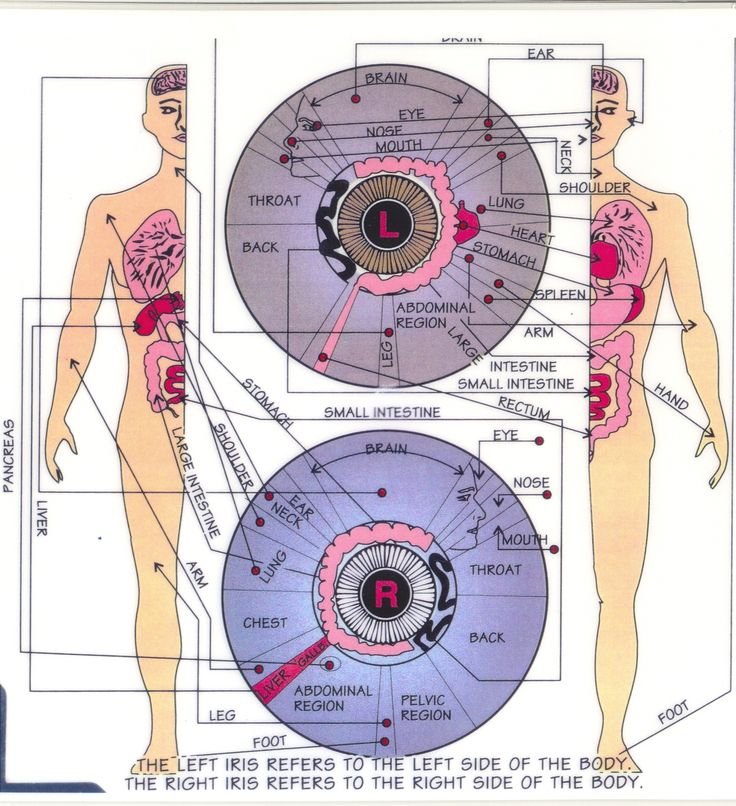
Dr. Jensen organized his iris chart using two primary mapping principles: radial divisions and concentric rings. Understanding this organization helps practitioners locate specific zones quickly when examining iris images.
Radial Clock Position System
Jensen divided each iris into 12 primary radial sectors corresponding to clock positions. This creates pie-slice divisions radiating from the pupil outward. Each clock position range contains specific organ zones based on Jensen’s observational correlations.
For example, the jensen iridology chart thyroid zone appears in both eyes near the 12 o’clock position, slightly offset toward the outer portions of the iris. Practitioners reference these clock positions when documenting observations or communicating findings.
Concentric Ring Organization
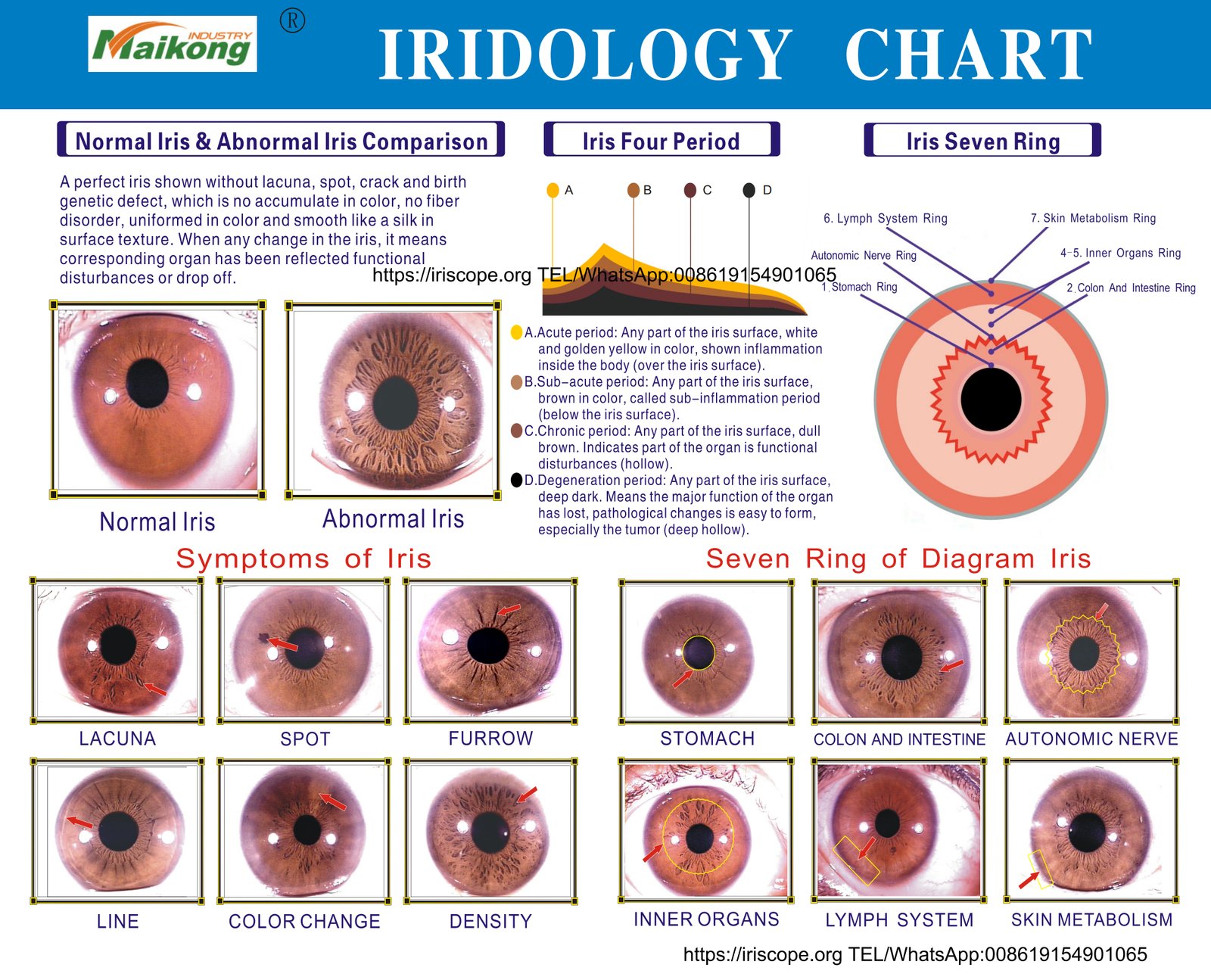
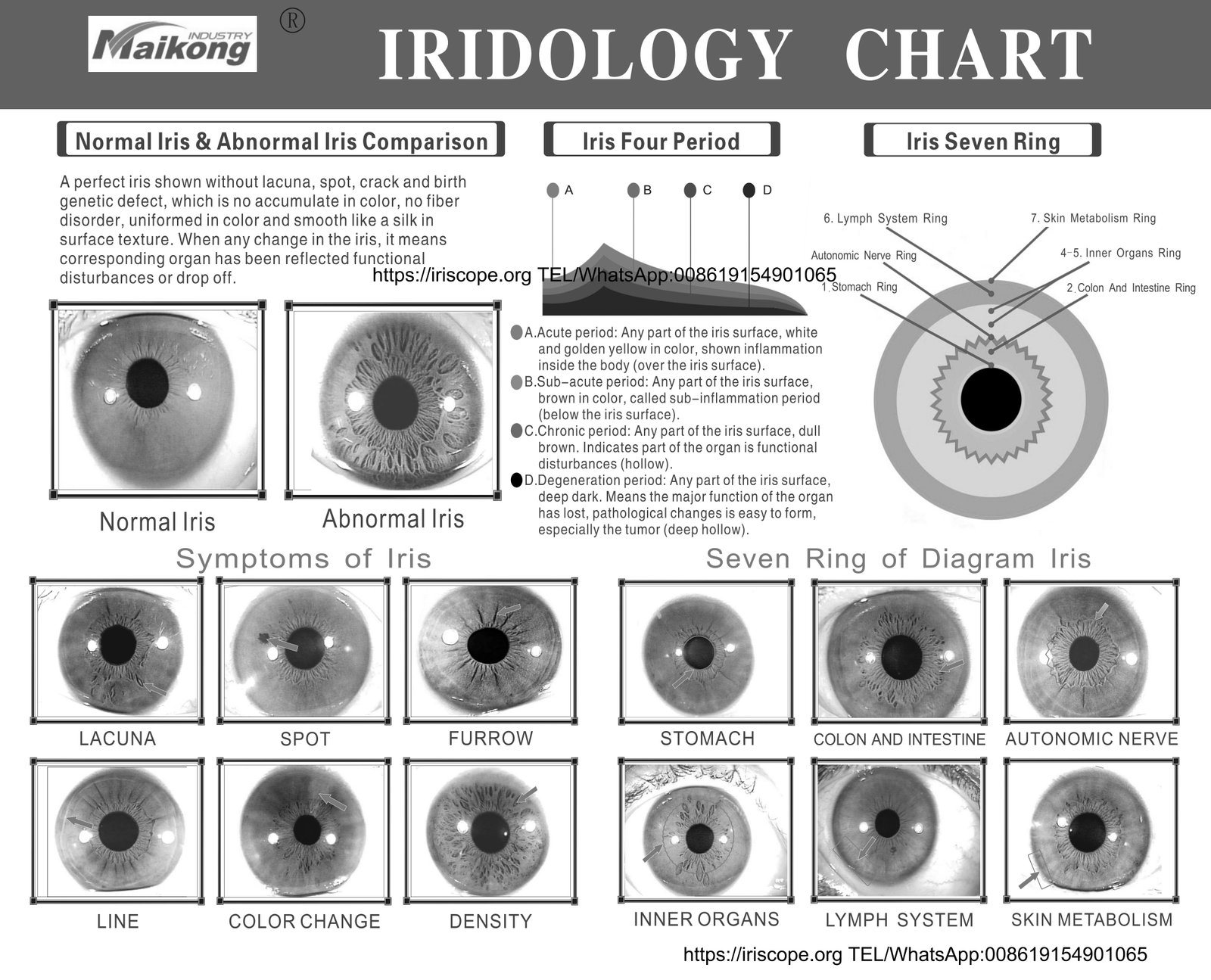
Jensen’s methodology also uses concentric rings moving outward from the pupil. These rings represent different body systems and tissue layers in traditional iridology theory:
Important Note: The following ring descriptions represent traditional iridology educational concepts used in Jensen’s chart system. These are not medical diagnostic zones and serve only as reference points for traditional iridology observation and study.
- Inner pupillary zone: stomach and digestive areas
- Mid-iris zones: various organ placements by radial position
- Ciliary zone: intermediate ring with specific organ mappings
- Outer peripheral zone: skin, lymphatic, circulatory references
- Autonomic nerve wreath: the jagged circular boundary between inner and outer iris
Professional best iridology camera systems capture high-resolution images that show these ring structures clearly. The MAIKONG MK-9822 12MP iriscope, for instance, provides sufficient image clarity to distinguish these subtle iris features when practitioners reference Jensen’s chart zones.
Bilateral Symmetry and Organ Pairing
Paired organs appear in corresponding positions on both eyes. Single organs appear only in one eye’s chart. The brain, for example, appears in the upper zones of both charts, while the liver zone appears predominantly in the right eye chart at the 7-8 o’clock position.
Step-by-Step Method for Reading the Jensen Iridology Chart
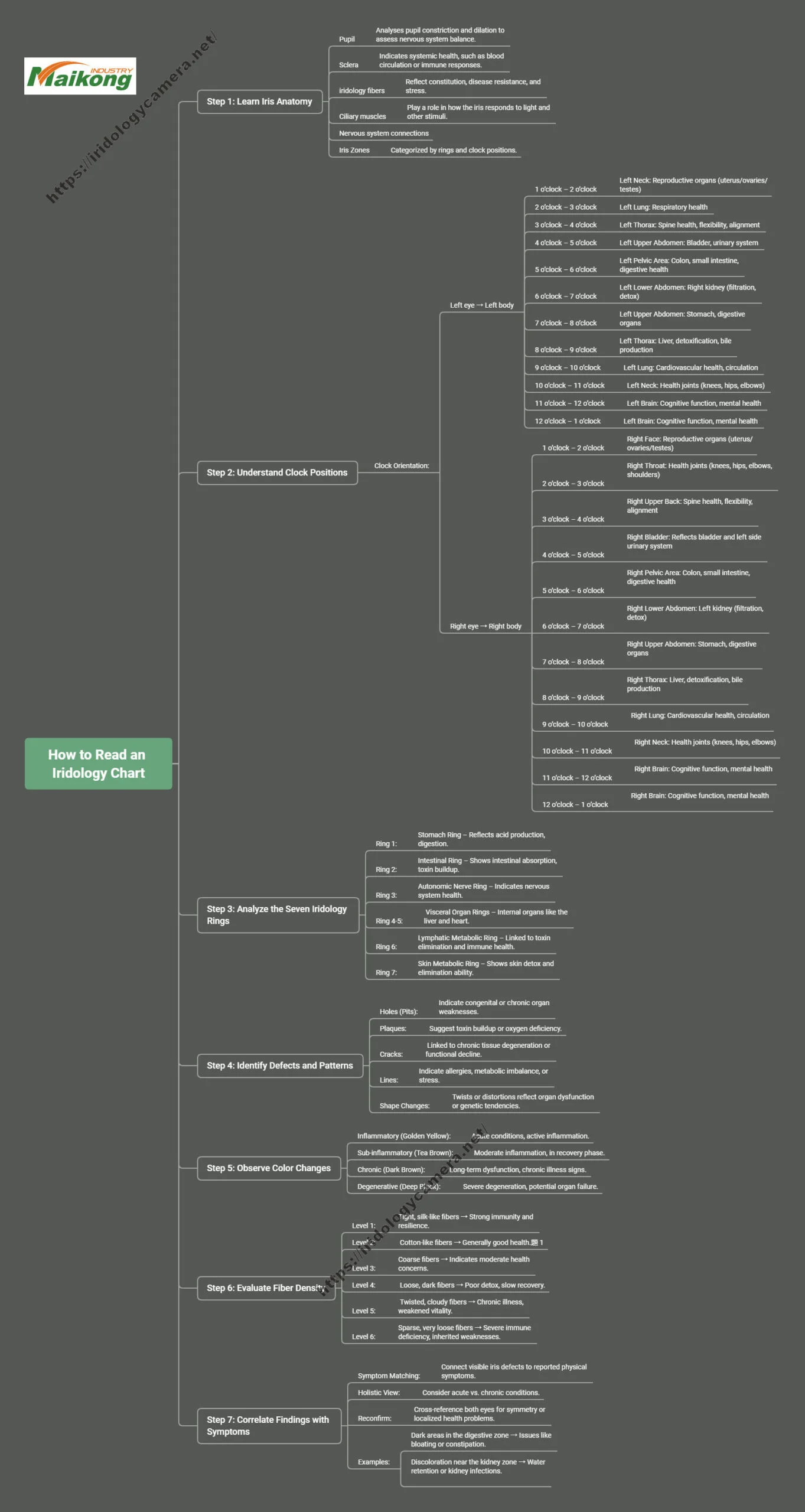
Learning iridology chart how to read techniques specific to Jensen’s methodology requires systematic practice. Here’s the approach professional iridologists use when applying the jensen iridology chart to iris observations.
Step 1: Capture Clear Iris Images
Start with high-quality iris photography using a professional iriscope. Image clarity directly affects your ability to identify iris features that correspond to chart zones. The MAIKONG equipment uses 12-megapixel sensors specifically to capture the fine details needed for zone identification.
- Position the camera lens perpendicular to the iris surface
- Adjust LED illumination to eliminate reflections while showing iris texture
- Focus carefully on iris fibers and structures
- Capture images of both left and right eyes
- Save images with proper client identification for documentation
Step 2: Identify the Autonomic Nerve Wreath
The autonomic nerve wreath (ANW) serves as a key landmark on Jensen’s chart. This jagged circular boundary separates the inner pupillary zone from the ciliary zone. Locating this structure helps orient the chart overlay correctly.
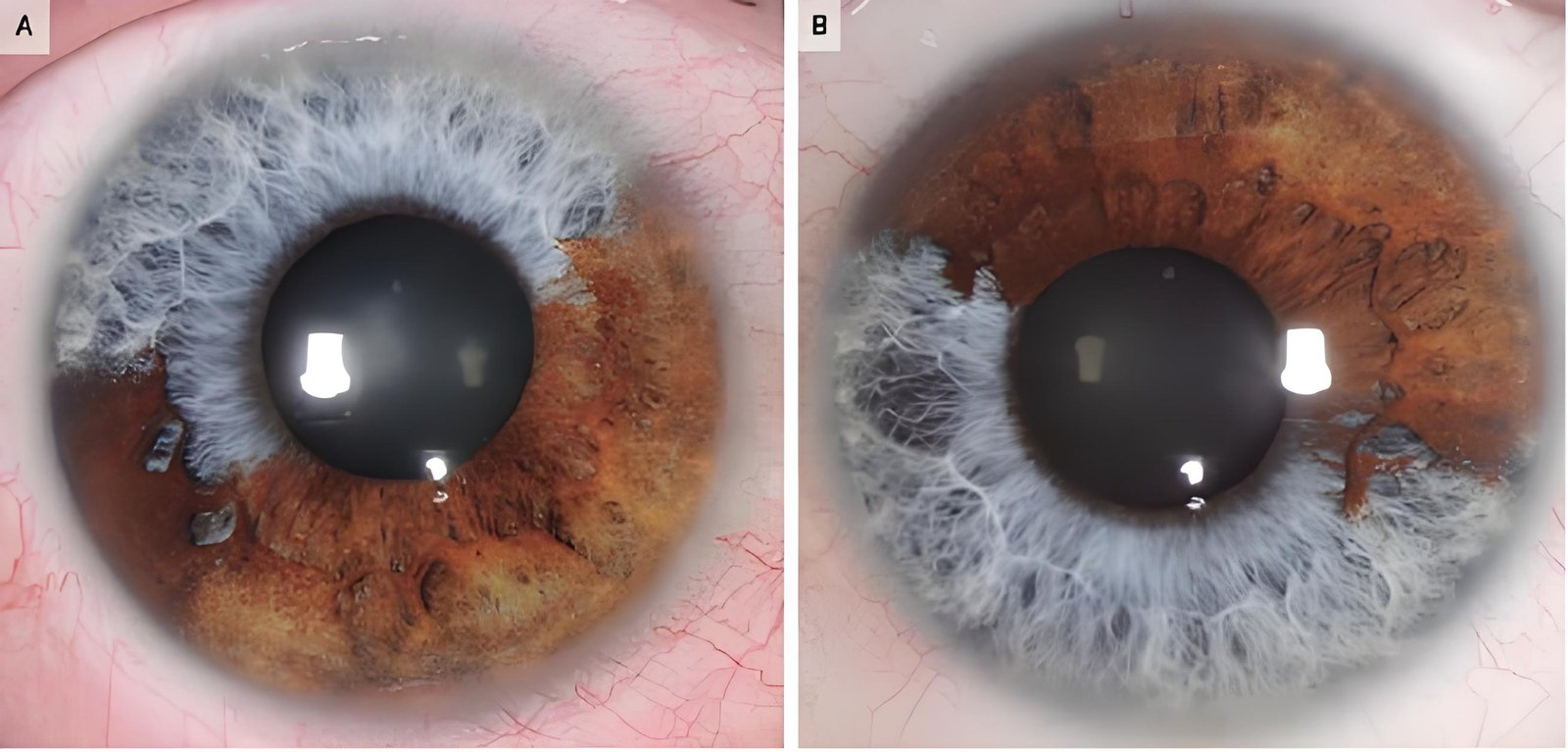
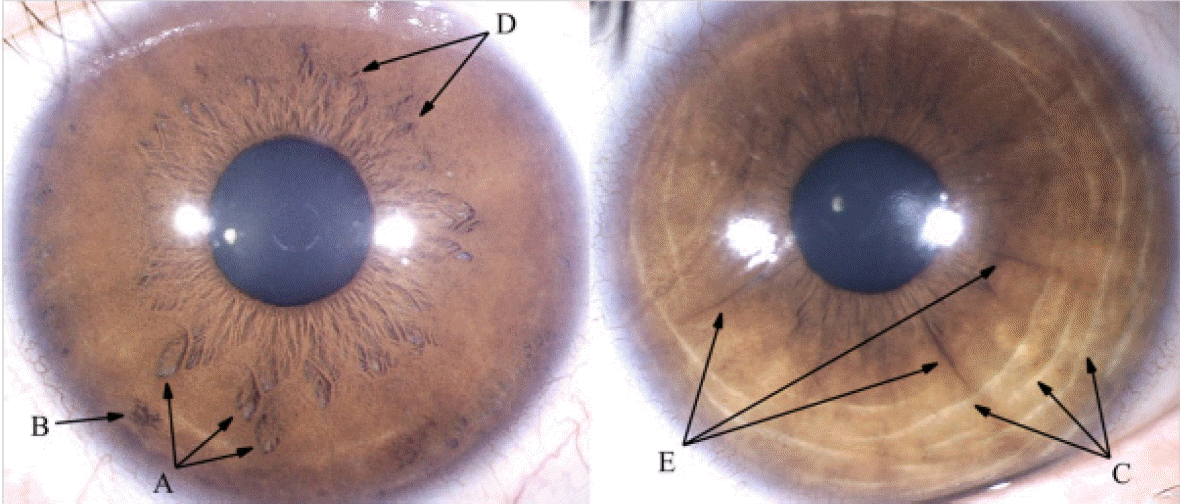
In captured iris images, the ANW appears as an irregular circular boundary with a zigzag or scalloped edge. Its position varies slightly between individuals, but it generally falls approximately one-third of the distance from pupil to iris outer edge.
Step 3: Apply Chart Overlay or Reference
Modern practitioners use two methods to reference the jensen iridology chart while examining iris images:
Digital Overlay Method
Advanced iridology software systems display Jensen’s chart zones as a transparent overlay on captured iris images. The MAIKONG 2024 software version includes this feature across all 17 language versions.
Practitioners can toggle the overlay on/off, adjust transparency, and rotate the chart to align with individual iris variations. This method provides real-time zone reference during client consultations.
Printed Chart Reference
Traditional practitioners keep iridology chart printable versions available during observations. This approach involves comparing the captured iris image against the printed jensen chart to identify corresponding zones.
High-quality printed charts work well for teaching environments where students learn zone locations through repeated manual reference and comparison.
Step 4: Identify Zones Using Clock Positions
Reference specific zones by combining clock position with ring location. For example, to find the heart zone in the left eye jensen chart, locate the 2-3 o’clock position in the mid-ciliary zone.
When documenting observations, practitioners note findings by zone description: “observation noted in left eye, liver zone, 7 o’clock position, outer ciliary ring.” This systematic approach ensures consistent documentation across sessions.

Step 5: Compare Bilateral Symmetry
Examine corresponding zones in both eyes for comparison. Paired organs should show similar iris features in mirror positions. Asymmetries between left and right eyes become apparent through this bilateral comparison process.
Professional practice involves photographing both eyes during each session and reviewing them side-by-side with Jensen chart reference to identify bilateral patterns or differences.
Understanding Abbreviations in the Jensen Iridology Chart
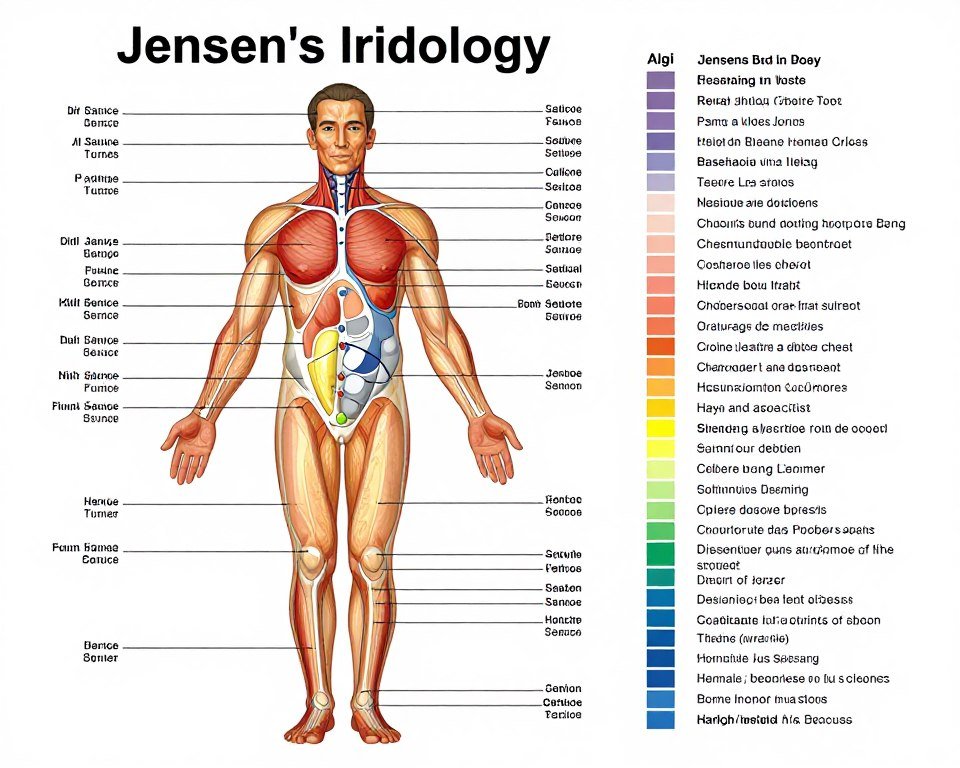
When practitioners ask “what are the abbreviations in the jensen iridology chart,” they’re referring to the shorthand notation Jensen used to label zones on his detailed chart versions. Understanding these abbreviations helps when working with professional printed charts or historical iridology documentation.
Common Zone Abbreviations
Jensen abbreviated organ and body region names to fit within the small zone spaces on the circular chart. Here are the most frequently encountered abbreviations:
| Abbreviation | Full Term | Zone Location | Eye |
| Thy | Thyroid | 12 o’clock, outer zone | Both |
| Pit | Pituitary | 12 o’clock, near pupil | Both |
| Brnch | Bronchi | 3-4 o’clock region | Both |
| SI | Small Intestine | Inner zones, radial | Both |
| AC | Ascending Colon | 5-7 o’clock path | Right |
| DC | Descending Colon | 5-7 o’clock path | Left |
| TC | Transverse Colon | Upper arc, both eyes | Both |
| Adr | Adrenal Gland | Near pupil, 3 o’clock | Both |
What Is Pey PT in the Jensen Iridology Chart
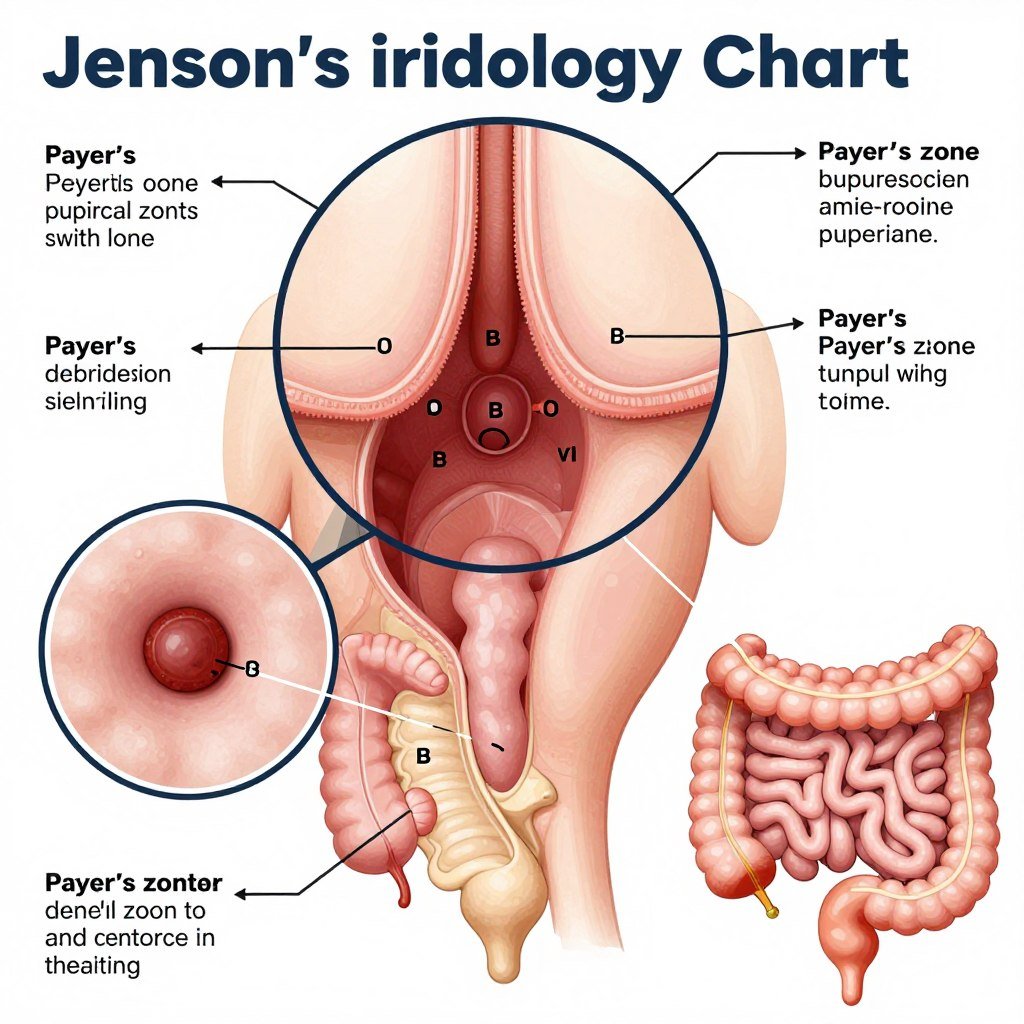
A frequent question practitioners encounter: “what is pey pt in the jensen iridology chart?” This abbreviation appears in some Jensen chart versions and refers to “Peyer’s Patches” – lymphoid tissue formations in the small intestine.
In traditional iridology theory, Peyer’s patches relate to immune function observations in the intestinal zones. On Jensen’s chart, this notation typically appears in the inner pupillary zone regions where small intestine segments are mapped.
System-Based Abbreviation Categories
Jensen organized abbreviations by body system to maintain chart readability:
- Digestive System: Stom (stomach), Duo (duodenum), Jeju (jejunum), Ileum, Colon segments
- Endocrine System: Thy (thyroid), Pit (pituitary), Adr (adrenal), Panc (pancreas)
- Respiratory System: Brnch (bronchi), Lng (lung), Pleur (pleura)
- Circulatory System: Hrt (heart), Circ (circulation)
- Urinary System: Kid (kidney), Blad (bladder), Urt (ureter)
Modern digital versions of the jensen iridology chart often spell out full organ names instead of using abbreviations. The MAIKONG iridology software displays complete zone labels in the user’s selected language, eliminating abbreviation confusion for multilingual practitioners.
Using Jensen Charts with Modern Iridology Cameras and Software
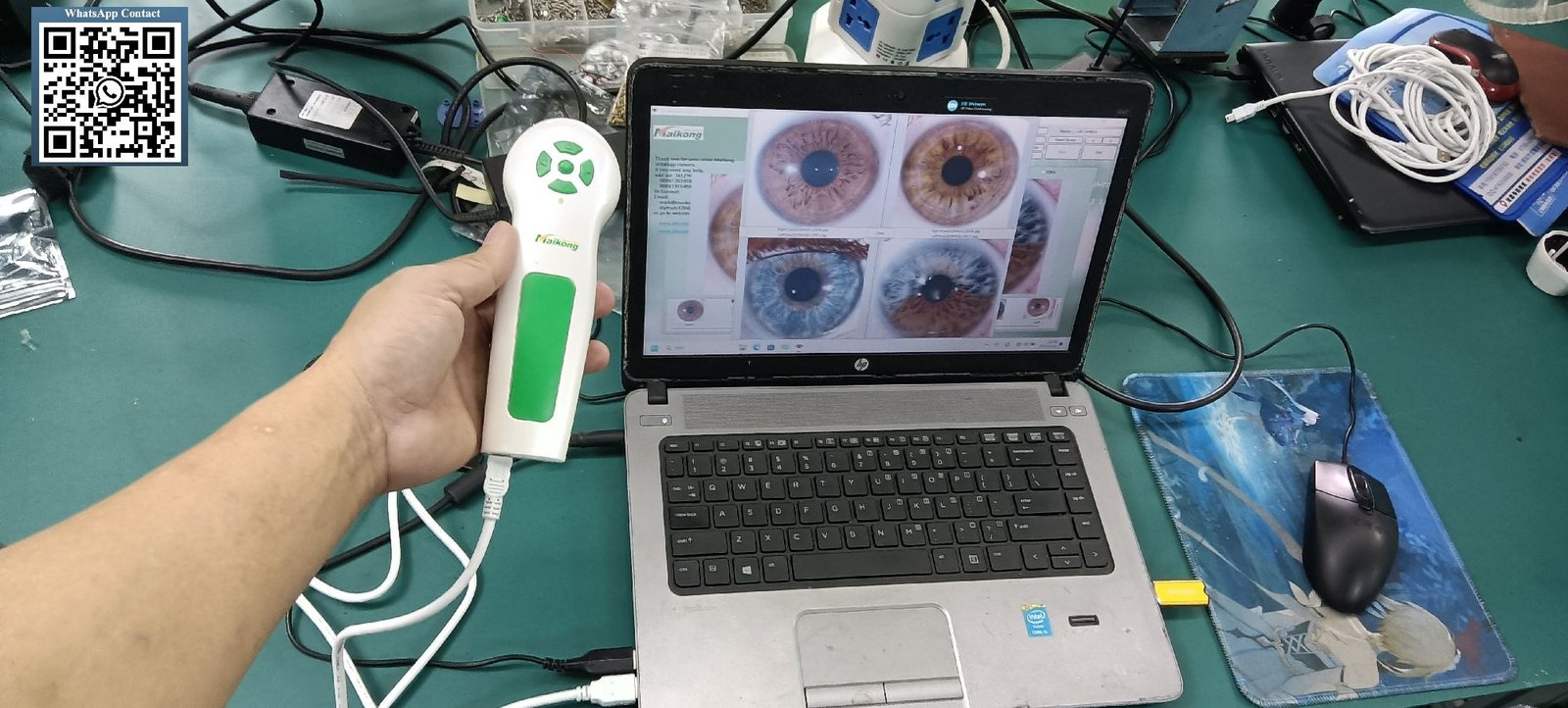
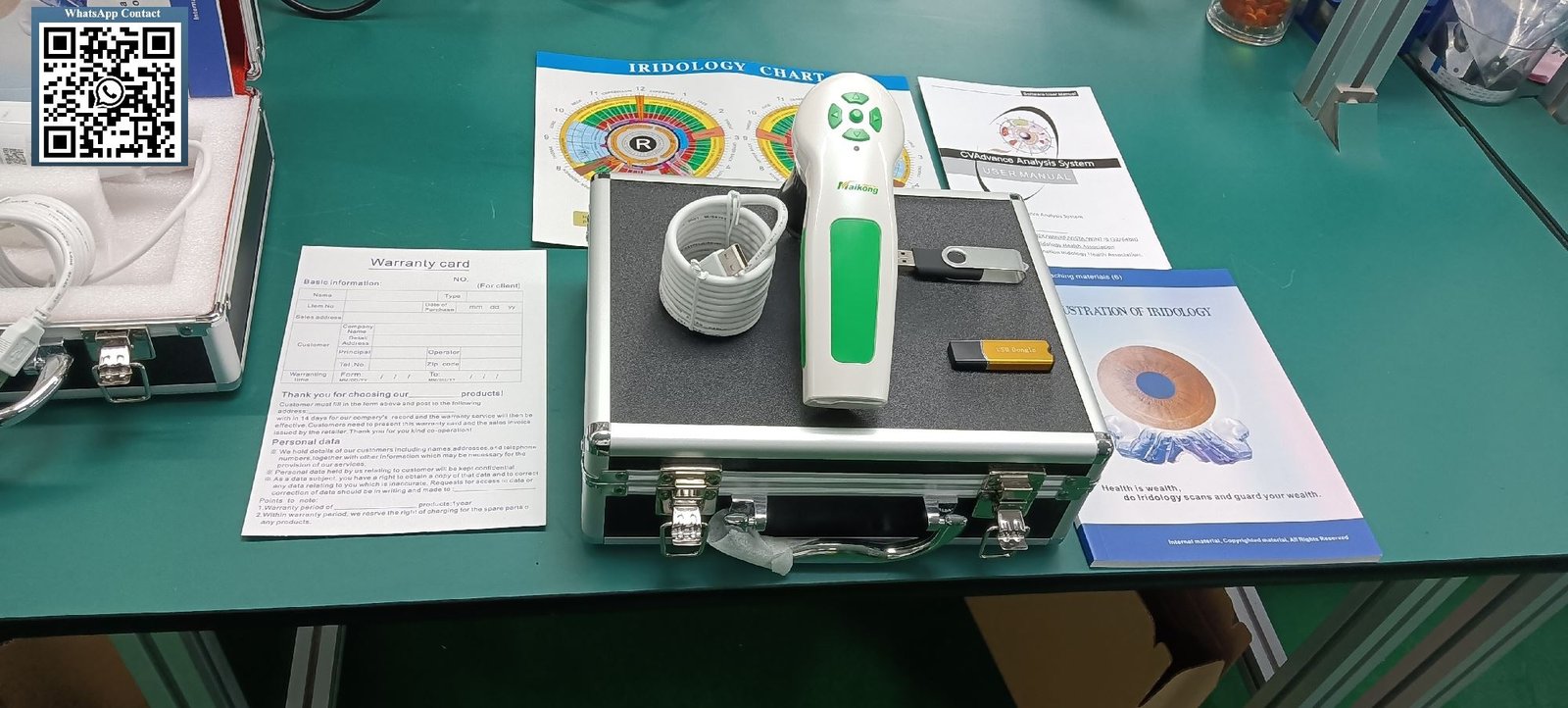
Today’s iridology practice integrates traditional Jensen chart methodology with advanced imaging technology. Understanding how the jensen iridology chart works within modern iridology camera systems helps practitioners maximize both educational value and client communication effectiveness.
Digital Chart Overlay Features
Contemporary iridology software systems include Jensen chart overlays as standard features. When practitioners capture iris images using equipment like the usb iridology camera systems, the software can superimpose Jensen’s zone map directly onto the photograph.
The MAIKONG 2024 software version provides adjustable overlay features:
- Transparency adjustment from 0-100% for clear zone visualization
- Rotation capability to align chart with individual iris variations
- Zoom functionality to examine specific zones in detail
- Toggle on/off for comparing raw iris image versus chart overlay
- Multiple chart style options including classic Jensen and modern variations
- Automatic left/right eye chart selection based on image metadata
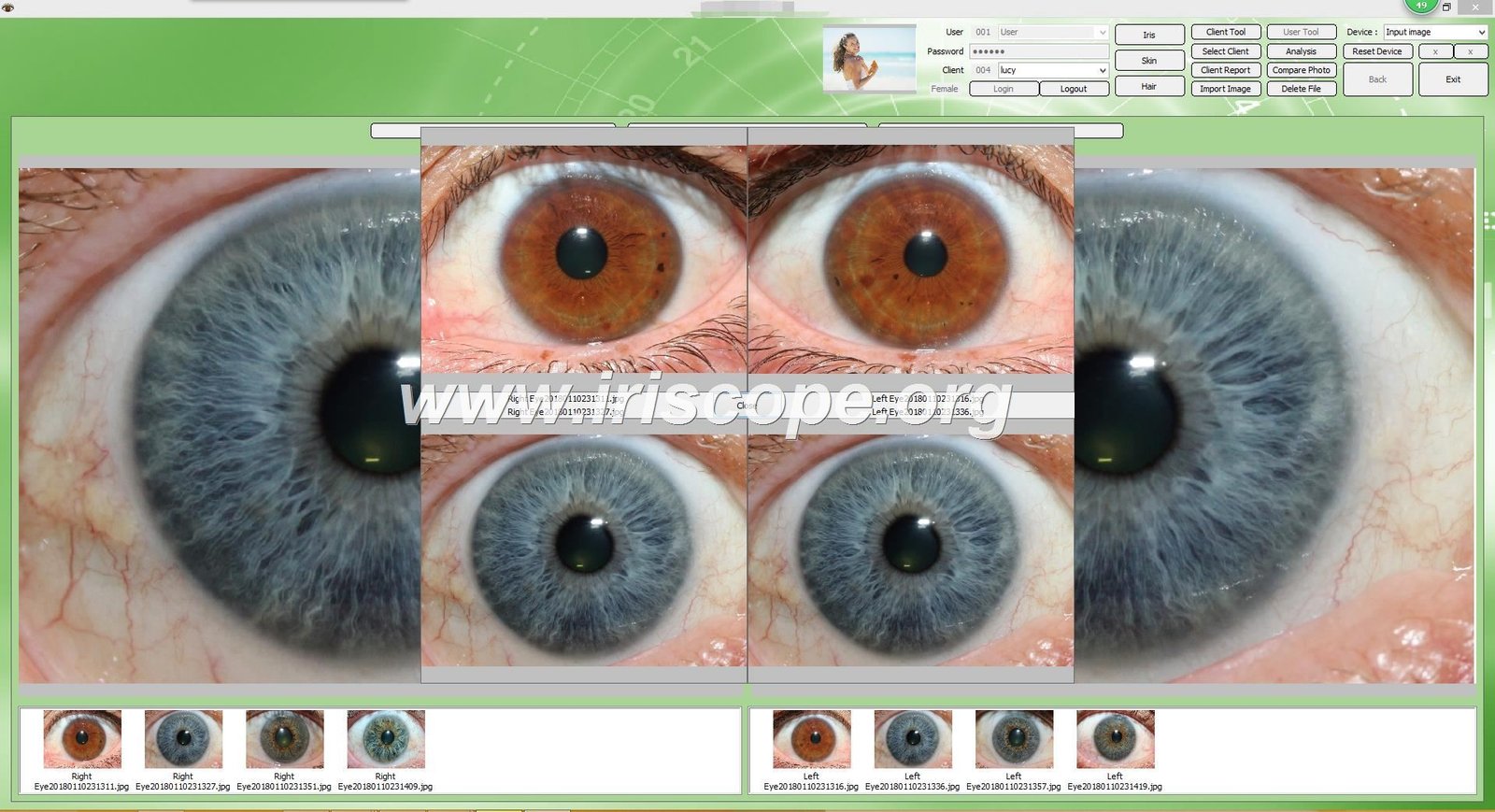
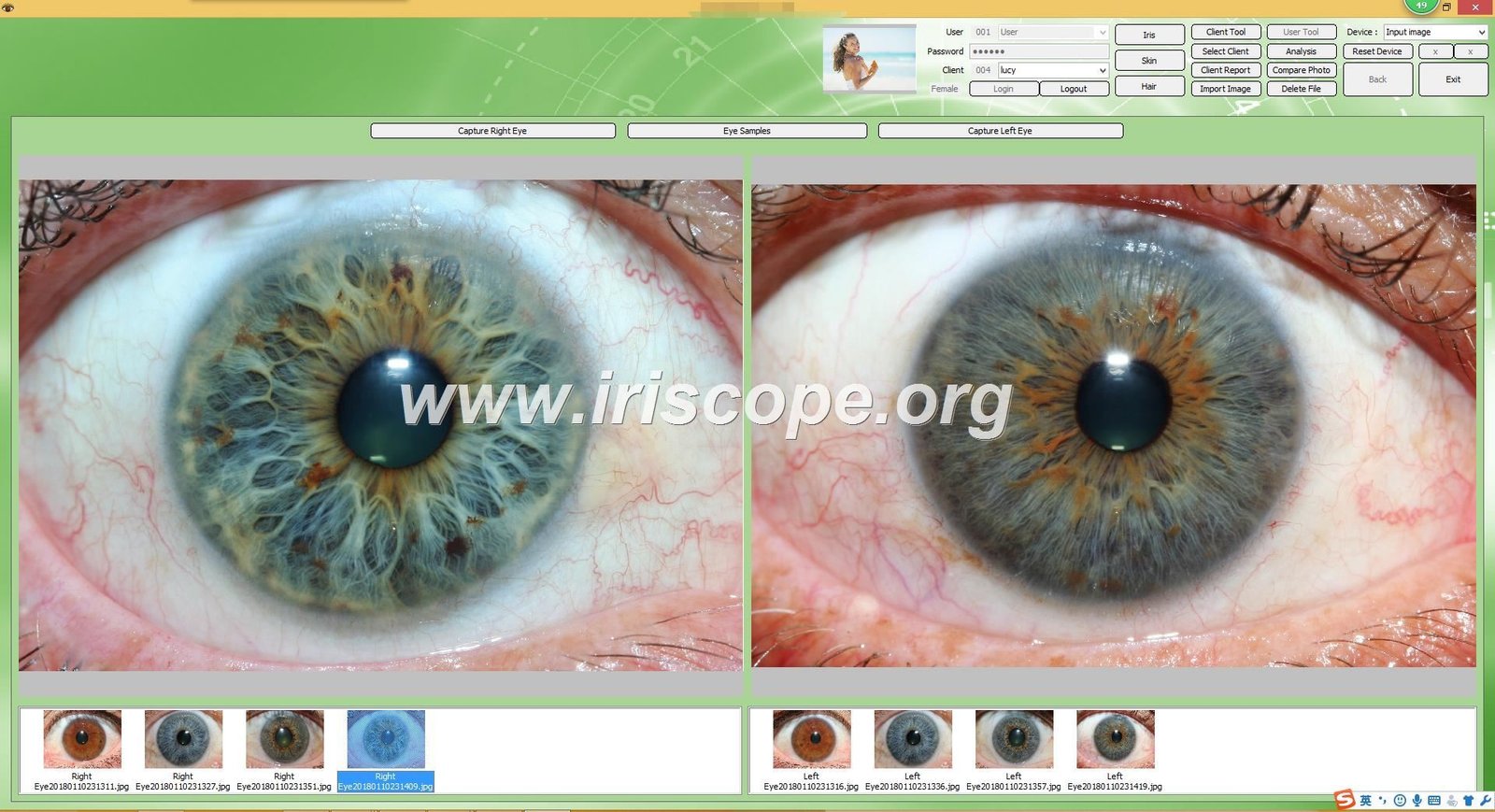
Multi-Language Chart Support
One significant advantage modern systems offer over printed charts: multilingual zone labeling. The MAIKONG software displays Jensen chart zones in 17 languages, making the traditional jensen iridology chart accessible to practitioners worldwide.
| Language | Chart Label Display | Software Version | Regional Application |
| English | Complete organ names | MAIKONG 2024 | North America, UK, Australia |
| Spanish | Nombres completos de órganos | MAIKONG 2024 | Latin America, Spain |
| German | Vollständige Organnamen | MAIKONG 2024 | Germany, Austria, Switzerland |
| French | Noms complets des organes | MAIKONG 2024 | France, Canada, Belgium |
| Simplified Chinese | 完整器官名称 | MAIKONG 2024 | Mainland China |
Integration with Client Management Systems
Professional iridology software platforms store jensen chart-referenced observations within client databases. Practitioners can document specific zone observations, attach chart screenshots, and track changes across multiple sessions.
This integration allows practitioners to generate reports showing Jensen chart zones alongside iris images, improving client education and communication. The ability to print or email reports with embedded jensen iridology chart references helps clients understand observations in context.
Professional Iridology Equipment with Jensen Chart Integration
MAIKONG manufactures iridology camera systems specifically designed to work seamlessly with Jensen chart methodology. Our MK-9822 12MP iriscope includes software with built-in jensen iridology chart overlays in 17 languages. Whether you’re practicing iridology or supplying equipment to clinics, our systems provide the tools needed for professional iris observation and client education.
Jensen Chart Applications in Teaching and Professional Practice

The dr jensen iridology chart serves multiple roles beyond individual practice. Understanding these applications helps practitioners, training institutions, and equipment suppliers maximize the educational value of Jensen’s systematic approach.
Student Training Programs
Iridology training institutions use the jensen iridology chart as the foundation for teaching systematic iris observation. Students learn zone locations, memorize organ placements, and practice identifying chart regions on sample iris images.
Effective training programs combine printed jensen charts with digital tools:
- Large wall-mounted charts showing both left and right eye zone maps
- Individual student chart handouts for zone memorization exercises
- Software-based training modules with interactive Jensen chart overlays
- Practice iris image libraries with known zone features for student identification
- Quiz systems testing zone location knowledge using clock positions and ring references
Client Education and Communication
Practitioners use simplified jensen chart graphics to help clients understand observations. Rather than showing the complete detailed chart with all zones, many practitioners create client-friendly versions highlighting only relevant zones discussed during consultations.
Modern iridology camera for sale packages often include client education materials featuring Jensen chart diagrams. These materials help practitioners explain traditional iridology concepts without overwhelming clients with technical complexity.
Clinic and Spa Applications
Natural health clinics, wellness spas, and integrative health centers incorporate jensen chart methodology into holistic health assessments. Staff trained in traditional iridology use Jensen’s systematic approach as one component within comprehensive wellness consultations.
Professional Practice Note: Clinics and wellness centers implementing iridology services must clearly communicate to clients that iris observations using Jensen charts represent traditional educational assessment methods, not medical diagnosis. These services complement but do not replace conventional medical examinations.
Equipment Demonstrations and Sales Support
Distributors and suppliers of iridology camera manufacturers equipment use jensen chart integration as a key selling feature. Demonstrating how modern cameras and software display Jensen zones helps potential buyers understand the practical value of professional equipment.
Effective product demonstrations include:
- Live iris image capture showing real-time chart overlay application
- Software navigation through Jensen zone database and labeling systems
- Multi-language chart display capabilities for international markets
- Report generation showing Jensen chart references in professional documentation
- Comparison between basic camera systems and professional equipment clarity when examining detailed zones
Jensen Chart Variations and Related Mapping Systems
While Dr. Jensen’s chart remains the most widely recognized mapping system, practitioners should understand that variations exist. The bernard jensen iridology chart evolved throughout his career, and other iridologists developed related but distinct mapping approaches.
Jensen’s Own Chart Revisions
Dr. Bernard Jensen refined his chart over several decades of practice. Early versions from the 1950s differ slightly from his later charts published in the 1980s and 1990s. These revisions reflected his accumulated observations and refined understanding of zone relationships.
Key differences between early and late Jensen charts:
Early Jensen Charts (1950s-1960s)
- Simpler zone divisions with fewer detailed sub-regions
- Limited color coding and zone differentiation
- Focus on major organ systems without extensive subdivision
- Hand-drawn illustrations with basic labeling
Later Jensen Charts (1980s-1990s)
- More detailed zone subdivisions and refined boundaries
- Enhanced color coding for different body systems
- Additional zones for glands, tissues, and specific organs
- Professionally printed versions with standardized formatting
Relationship to Other Iridology Charts
Jensen’s methodology influenced many subsequent iridology practitioners who developed their own chart variations. Understanding these relationships helps practitioners recognize different approaches:
- European Iridology Charts: Josef Deck and other European practitioners created alternative zone mappings with different theoretical foundations
- Modern Integrated Charts: Contemporary charts sometimes combine Jensen zones with additional markings from other systems
- Simplified Educational Charts: Teaching-focused versions reduce complexity for beginner students
- Digital-Enhanced Charts: Software-based charts add interactive features and multi-layer zone displays
Choosing the Right Chart for Your Practice
Practitioners often ask which jensen chart version to use. The answer depends on training background, practice focus, and available tools. Most contemporary iridology education programs teach the later, more detailed Jensen charts as the standard reference.
When selecting iridology equipment, verify which chart versions the software includes. The MAIKONG system provides the comprehensive late-period Jensen chart as its default reference while allowing practitioners to customize zone labels and boundaries based on their preferred methodology.
Common Mistakes When Using Jensen Iridology Charts
Even experienced practitioners can make systematic errors when applying the jensen iridology chart to iris observations. Recognizing these common mistakes improves accuracy and professional credibility.
Mistake 1: Incorrect Chart Orientation
The most frequent error involves applying the wrong eye’s chart to an iris image. Left and right eye charts are mirror images, and using the incorrect chart reverses all zone locations.
Prevention strategy: Always verify image metadata showing which eye was photographed before applying chart overlays. Modern iridology camera systems automatically tag images as left or right eye during capture, and professional software uses this metadata to select the appropriate Jensen chart automatically.
Mistake 2: Misidentifying Clock Positions
Practitioners sometimes miscount clock positions, especially when working with iris images that aren’t perfectly aligned or centered. A position identified as 3 o’clock might actually be 2:30 or 3:30, shifting zone identification.
Solution approach: Use software grid overlays that display clock position markers directly on iris images. The MAIKONG software includes this feature, showing numbered clock positions around the iris perimeter to ensure accurate zone location.
Mistake 3: Over-Interpreting Minor Features
Some practitioners assign significance to every tiny iris variation, attempting to correlate all features with Jensen chart zones. This approach can lead to overreach beyond the chart’s intended educational purpose.
Professional guideline: Remember that the jensen iridology chart serves as a systematic observation framework for traditional iridology education, not a diagnostic tool. Focus on systematic observation and documentation rather than making health claims based on minor iris features.
Mistake 4: Ignoring Individual Iris Variations
Not every iris fits Jensen’s standardized chart perfectly. The autonomic nerve wreath position varies between individuals, and iris structure shows natural diversity. Forcing a rigid chart overlay onto every iris ignores biological variation.
Adaptive approach: Use chart overlays as flexible guides rather than absolute templates. Professional software allows overlay adjustment to accommodate individual iris anatomy while maintaining general zone reference relationships.
Mistake 5: Neglecting Bilateral Comparison
Examining only one eye without referencing the corresponding zones in the other eye misses important comparative information. Jensen’s methodology emphasizes bilateral observation for paired organ zones.
Best practice: Always capture and examine both eyes during sessions. Display left and right iris images side-by-side with their respective Jensen chart overlays to facilitate systematic bilateral comparison.
Bilateral Comparison Checklist
- Capture both eyes during same session for consistency
- Use identical lighting and focus settings for comparable images
- Display both images at same scale and orientation
- Apply appropriate left/right eye Jensen charts to respective images
- Systematically compare corresponding zones between eyes
- Document any notable bilateral asymmetries
- Reference previous session images for longitudinal comparison
Frequently Asked Questions About Jensen Iridology Charts
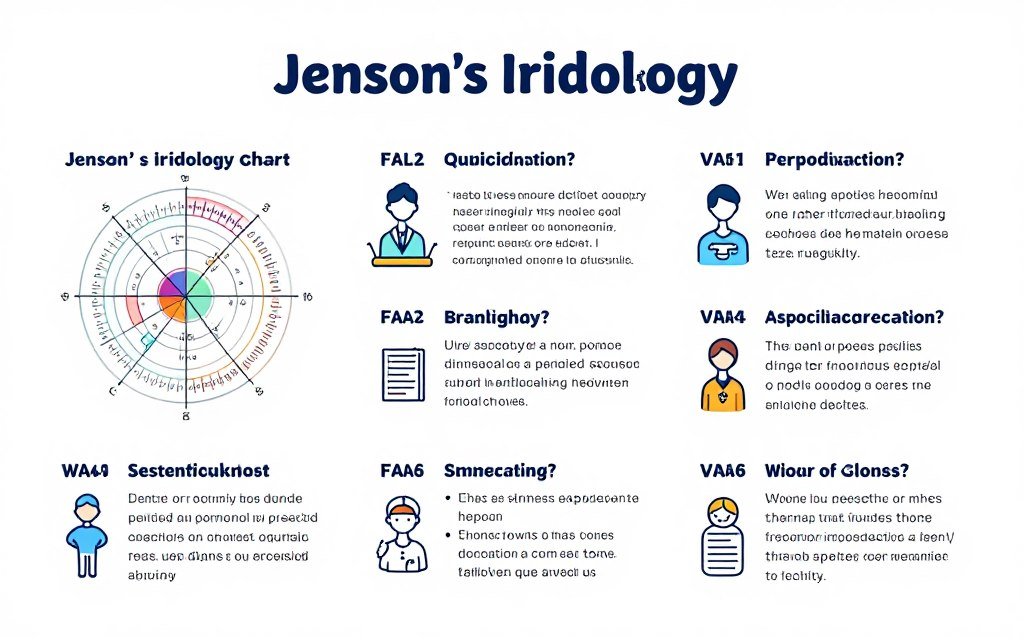
What is the difference between left and right eye Jensen iridology charts?
The jensen iridology chart for the left eye and right eye show mirror-image zone arrangements. Paired organs appear in corresponding positions on both charts, while single organs appear only in one chart. For example, the heart zone appears in the left eye chart at approximately 2-3 o’clock, while the liver zone appears predominantly in the right eye chart at 7-8 o’clock. The digestive system zones follow pathways that mirror the body’s actual anatomical layout, with the ascending colon mapped in the right eye and descending colon in the left eye.
Where exactly is the jensen iridology chart thyroid zone located?
The thyroid zone on the jensen iridology chart appears in both eyes near the 12 o’clock position in the outer ciliary zone, slightly offset toward the peripheral edge. More specifically, it occupies approximately the 11:30 to 12:30 clock range in the outer third of the iris radius. This placement reflects traditional iridology’s association of upper iris regions with head and neck structures. When examining iris images with chart overlays, look for this zone just below the top center of the iris, extending toward the outer boundary.
Can I download a printable version of the jensen iridology chart?
Yes, iridology chart printable versions of Jensen’s charts are available through educational resources and professional iridology equipment suppliers. High-resolution printable Jensen charts allow practitioners to create wall displays for training environments or quick-reference guides for practice use. The MAIKONG iridology software includes export functions that generate printable Jensen chart graphics customized in your preferred language, with adjustable detail levels suitable for different educational or professional applications.
What do the abbreviations like “Pey PT” mean on detailed Jensen charts?
Many practitioners wonder “what is pey pt in the jensen iridology chart” and similar abbreviations. “Pey PT” refers to Peyer’s Patches, lymphoid tissue formations in the small intestine that traditional iridology theory associates with immune function observations. Other common abbreviations include “Thy” for thyroid, “Adr” for adrenal glands, “Brnch” for bronchi, and various digestive system abbreviations like “SI” (small intestine) and “AC/DC” (ascending/descending colon). Modern digital chart versions typically spell out full organ names in your selected language, eliminating confusion around these traditional abbreviations.
How accurate is the Jensen iridology chart for health assessment?
It’s essential to understand that the jensen iridology chart serves as an educational reference framework for traditional iridology observation and study, not as a medical diagnostic tool. The chart represents Dr. Jensen’s systematic approach to organizing iris observations based on traditional iridology theory. Scientific research has not validated iridology as a diagnostic method, and iris observations using Jensen charts cannot diagnose diseases or replace medical examinations. Professional practitioners use the chart as one component within comprehensive wellness consultations, always making clear to clients that observations represent traditional educational assessment methods and recommending appropriate medical consultation for health concerns.
Do modern iridology cameras automatically apply Jensen chart overlays?
Professional iridology camera systems include software that can automatically apply Jensen chart overlays to captured iris images. The MAIKONG MK-9822 iriscope, for example, works with software that recognizes which eye was photographed and applies the appropriate left or right eye Jensen chart overlay. Practitioners can adjust overlay transparency, rotation, and position to align with individual iris anatomy. The software stores chart preferences within client profiles, maintaining consistency across multiple observation sessions. This automation streamlines the observation process while ensuring accurate chart-to-image alignment.
What’s the best way to learn Jensen chart zone locations?
Effective Jensen chart learning combines multiple approaches: systematic memorization of major zones by clock position and ring location, regular practice identifying zones on sample iris images, use of interactive software training modules with instant feedback, study of printed charts with self-testing on zone identification, and practical application during supervised training sessions. Many practitioners find that teaching Jensen chart methodology to others solidifies their own understanding. The MAIKONG software includes training mode features that quiz users on zone identification, helping students build reliable Jensen chart knowledge through repetition and practical application.
Professional Iridology Equipment Solutions from MAIKONG
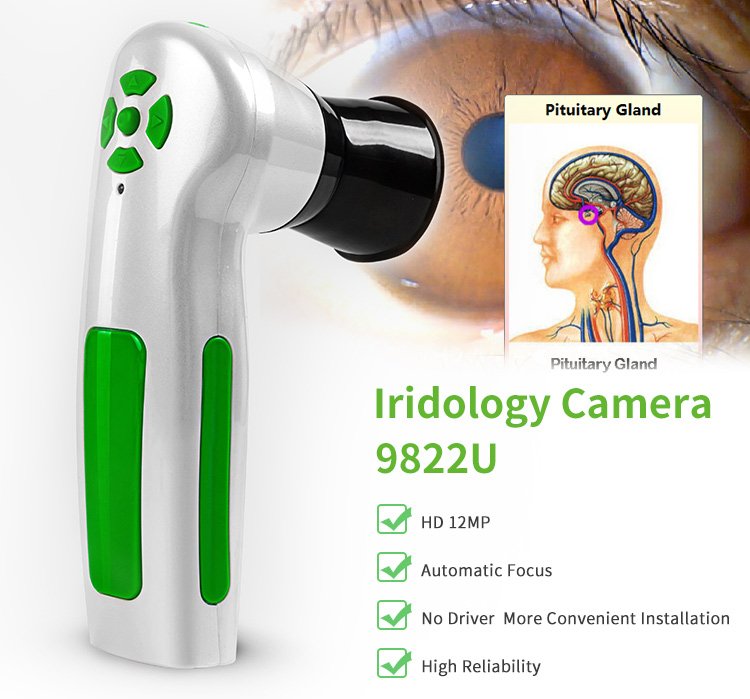
As a leading iridology camera manufacturers based in SZ, GD, China, MAIKONG has specialized in professional iris observation equipment for over 20 years. We understand the critical importance of accurate Jensen chart integration in modern iridology practice.
MAIKONG MK-9822 Iriscope: Complete Jensen Chart Integration
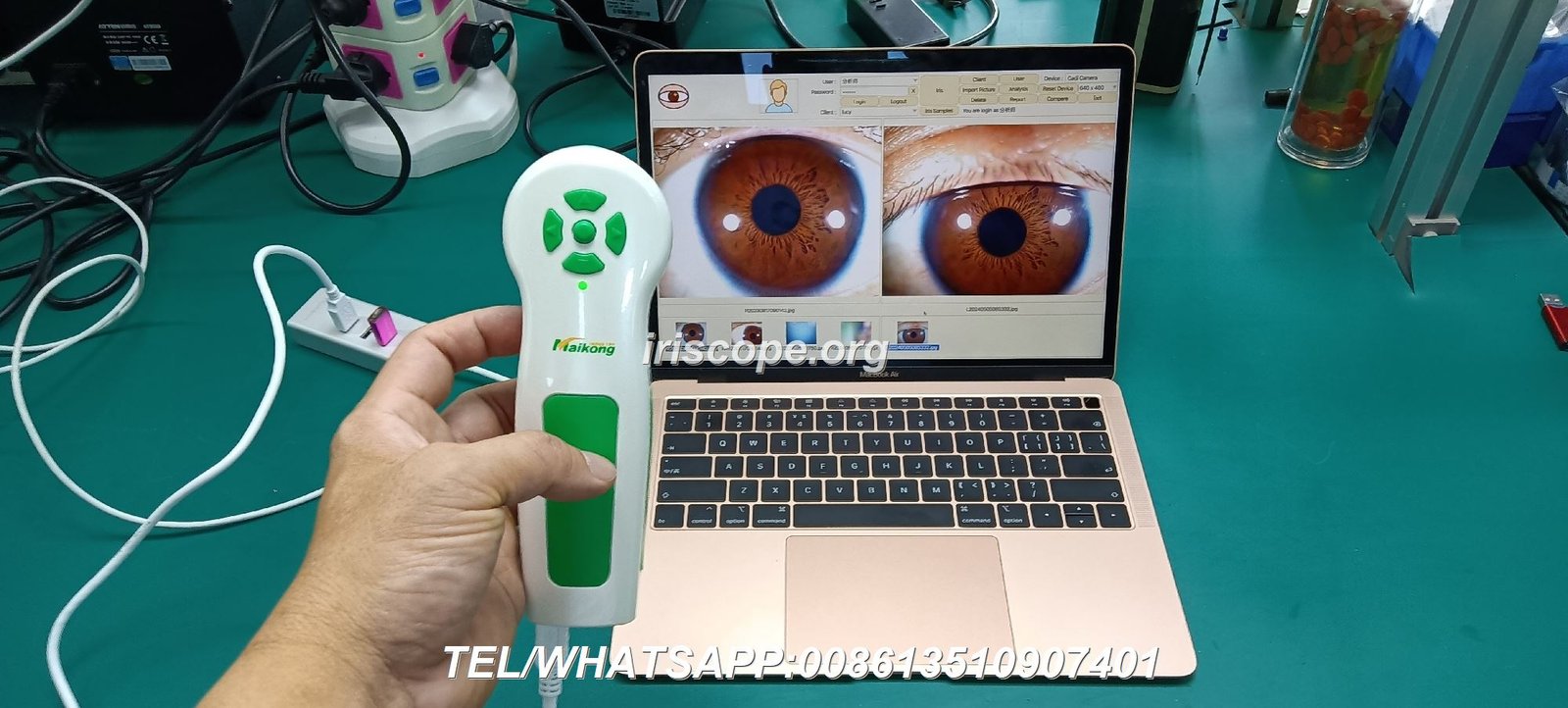
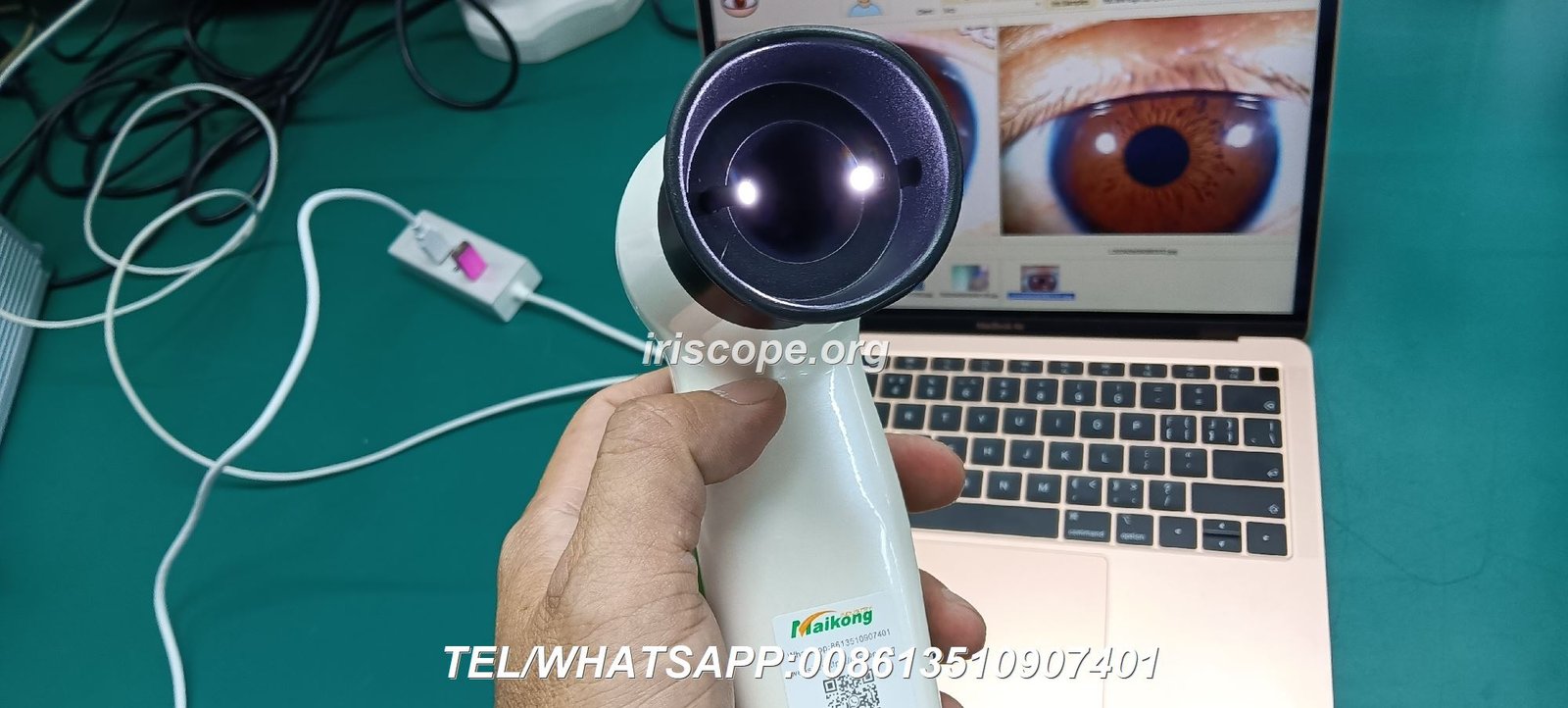
Our flagship MK-9822 12-megapixel iriscope system provides the image clarity needed to identify detailed iris features that correspond to Jensen chart zones. The system includes comprehensive software featuring built-in jensen iridology chart overlays in 17 languages.
| Specification | Details |
| Model Number | MAIKONG MK-9822 |
| Sensor Resolution | 12.0 Megapixels CCD |
| Lens Type | Imported optical lens with anti-reflective coating |
| Illumination | Adjustable LED ring light around lens |
| Focus System | Manual adjustment for precise iris detail capture |
| Connection | USB 2.0/3.0 compatible |
| Power Supply | USB-powered (no external power required) |
| Operating Systems | Windows XP/Vista/7/8/10/11 (32-bit & 64-bit), macOS 10.14-15 |
| Included Accessories | 30X iris lens, lens protective cover, 1.5m USB cable, leather carrying case |
| Documentation | Jensen iridology chart (printed), instruction manual, warranty card |
| Software | MAIKONG 2024 version with Jensen chart overlays |
| Warranty | 1 year manufacturer warranty |
| Certification | CE certified, ISO9000 manufacturing standards |
MAIKONG 2024 Software: Advanced Jensen Chart Features
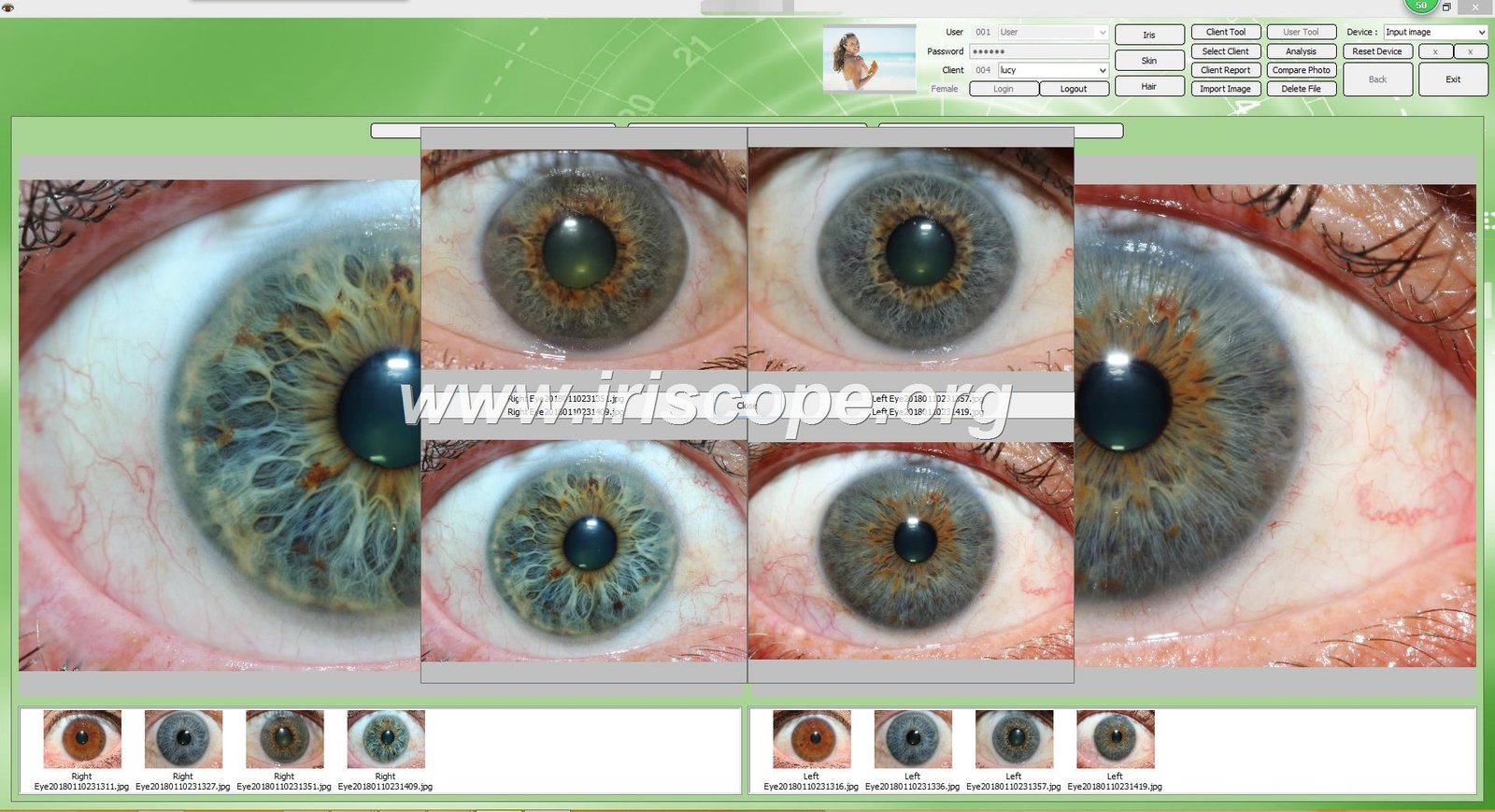
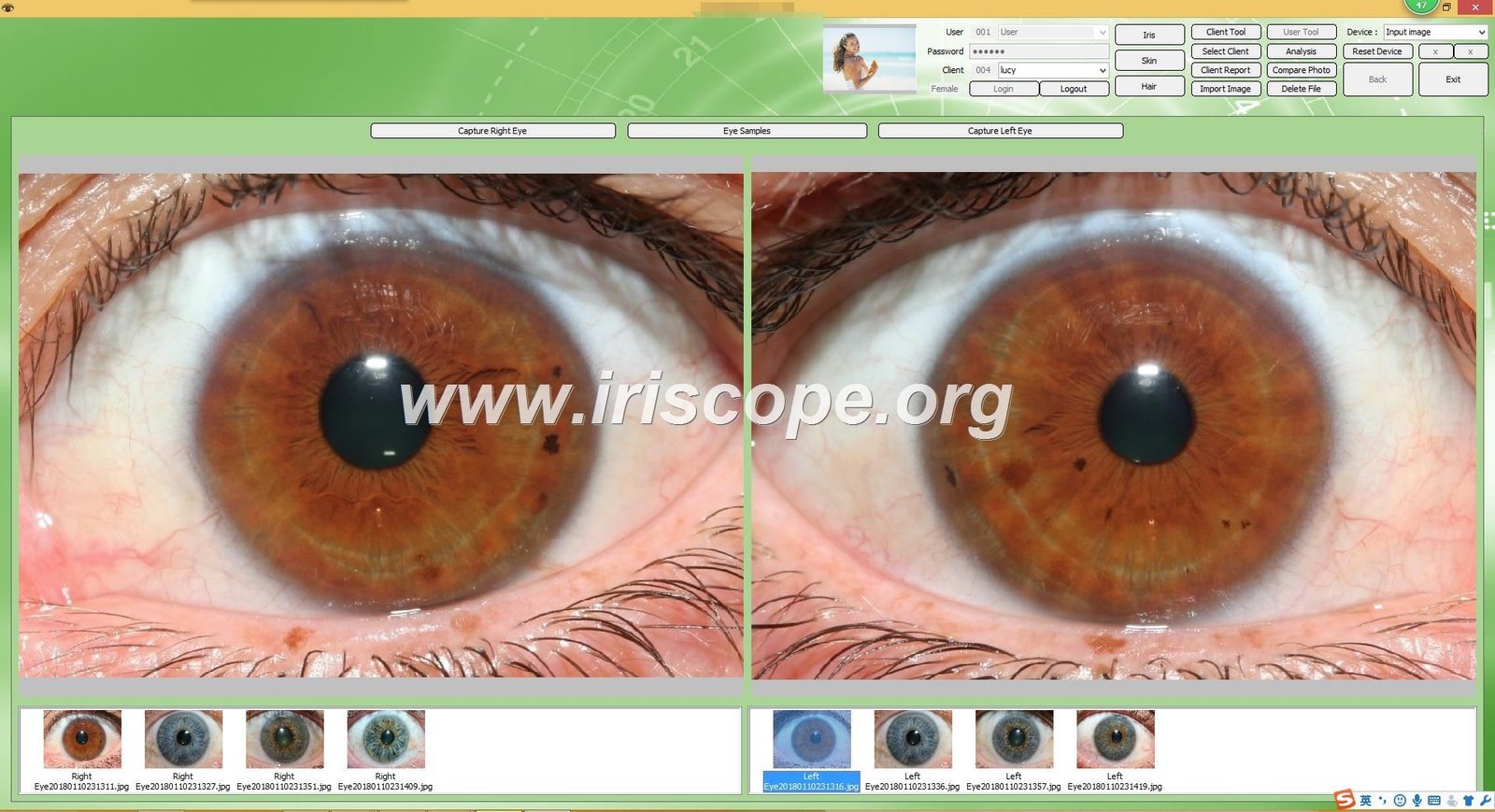
Our iridology software provides comprehensive Jensen chart functionality specifically designed for professional practice and training applications.
| Software Feature | Description | Benefit for Jensen Chart Use |
| Multi-Language Chart Display | Jensen chart zone labels in 17 languages | Serve international clients and multilingual markets |
| Adjustable Overlay Transparency | 0-100% transparency control for chart overlay | Balance chart visibility with iris feature examination |
| Chart Rotation and Alignment | Rotate and position chart to match iris anatomy | Accommodate individual iris variations accurately |
| Automatic Eye Detection | Software identifies left vs. right eye automatically | Prevents chart orientation errors |
| Zone-Based Documentation | Click zones to add observations and notes | Systematic record-keeping by Jensen zones |
| Client Report Generation | Create printable reports with chart references | Professional client education materials |
| Bilateral Comparison View | Display both eyes side-by-side with charts | Efficient bilateral zone comparison |
| Historical Session Tracking | Archive iris images with chart overlays over time | Track changes in specific Jensen zones |
OEM and ODM Customization for Distributors
MAIKONG offers comprehensive customization services for distributors, wholesalers, and brand partners seeking to offer iridology equipment with Jensen chart capabilities under their own branding.
Our OEM/ODM services include:
- Hardware Customization: Custom model numbers, exterior colors, logo placement on equipment
- Software Branding: Your company logo and branding throughout software interface
- Language Customization: Additional language support beyond our standard 17 languages
- Chart Customization: Integrate modified Jensen charts or additional mapping systems
- Feature Development: Custom software features tailored to your market needs
- Packaging Design: Custom packaging and documentation with your branding
- Training Materials: Customized Jensen chart educational resources for your customers
With 20 years of manufacturing experience and over 1,000 successful OEM/ODM partnerships, MAIKONG provides reliable customization services that help distributors enter or expand their presence in the professional iridology equipment market.
Wholesale and Distribution Opportunities
We actively seek partnerships with qualified distributors in the United States and internationally. Our distribution program provides:
US Market Advantages
- Warehouse inventory maintained in the United States for faster delivery
- Competitive wholesale pricing structures for volume orders
- Technical support in English via email and phone
- Marketing materials featuring Jensen chart integration
- Demonstration equipment available for qualified distributors
Partner Support Services
- Comprehensive product training on Jensen chart features
- Software customization for regional requirements
- Ongoing technical support for your customers
- Regular software updates including chrt enhancements
- Protected territory options for exclusive distributors

Maximizing Value from Jensen Iridology Chart Methodology
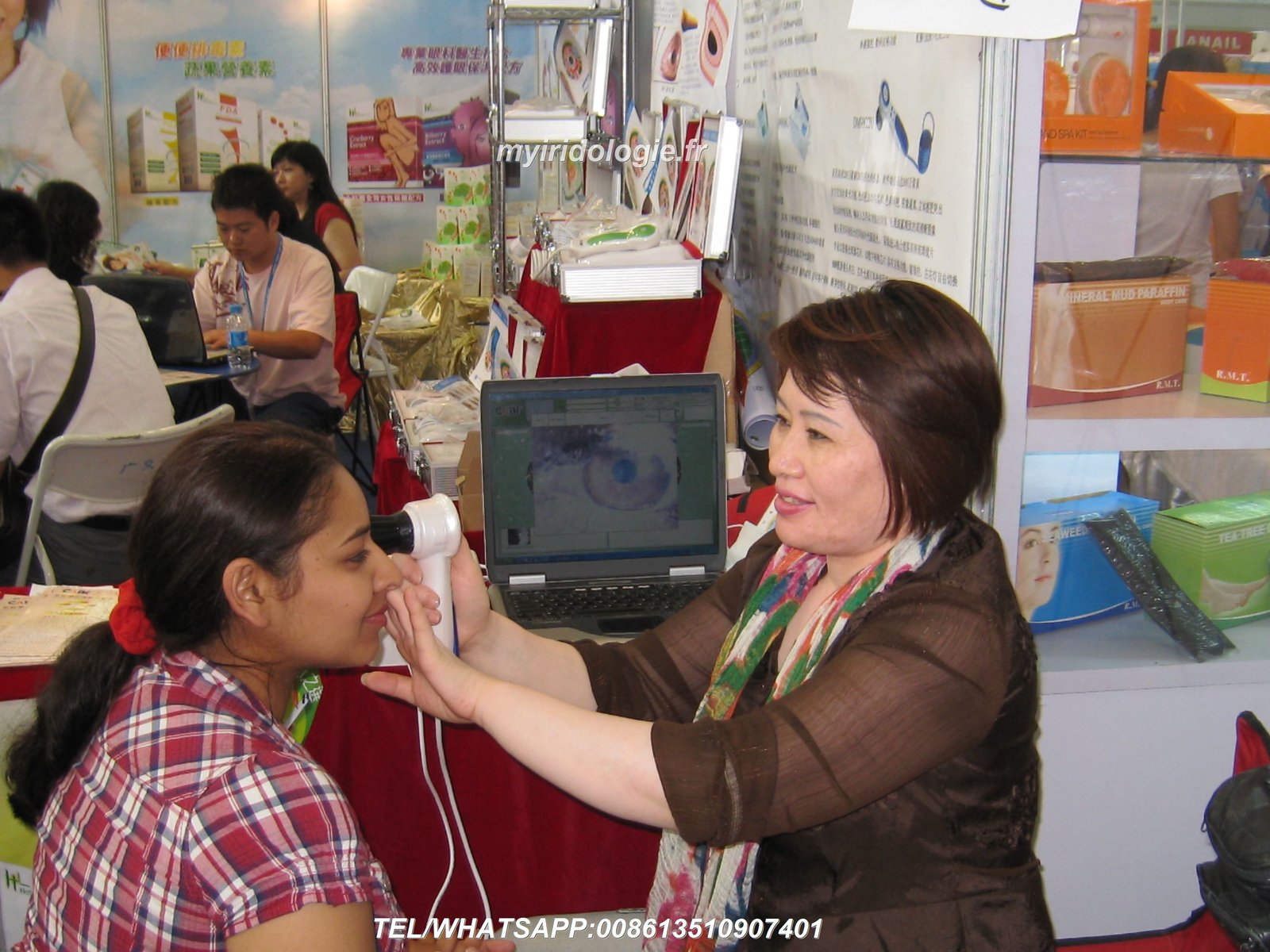

The jensen iridology chart remains a foundational educational tool in traditional iridology practice and training. Understanding Dr. Jensen’s systematic zone mapping methodology provides practitioners with a structured framework for iris observation and client communication.
Modern integration of Jensen charts with professional iridology camera systems and advanced software enhances the practical value of this traditional methodology. Digital overlays, multi-language support, automated zone identification, and comprehensive documentation features make Jensen’s approach more accessible and applicable in contemporary practice environments.
For practitioners, training institutions, and health centers implementing iridology services, quality equipment with robust Jensen chart integration proves essential. The ability to capture clear iris images, apply accurate chart overlays, document observations systematically, and generate professional reports elevates the educational value practitioners can offer clients.
For distributors, wholesalers, and equipment suppliers, offering professionally manufactured iridology systems with comprehensive Jensen chart features addresses a clear market need. Practitioners worldwide seek reliable tools that honor traditional methodologies while incorporating modern technological advantages.
Professional Practice Reminder: All iris observations using jensen iridology chart methodology represent traditional iridology educational assessments. These observations serve as one component within holistic wellness consultations and do not constitute medical diagnosis. Always recommend clients consult qualified healthcare providers for medical concerns and diagnostic needs.
The ongoing relevance of Jensen’s systematic approach demonstrates the value of organized observation frameworks in traditional health practices. As modern technology continues advancing iris imaging capabilities, Jensen’s foundational zone mapping system provides the structured methodology needed to apply these technological tools effectively.
Partner with MAIKONG for Professional Iridology Equipment Solutions

Whether you’re an established distributor seeking to add professional iridology equipment to your product line, a natural health clinic outfitting your practice with Jensen chart-integrated tools, or an entrepreneur exploring opportunities in the wellness equipment market, MAIKONG provides the manufacturing expertise, product quality, and partnership support you need.
Our MK-9822 iriscope systems with comprehensive jensen iridology chart integration serve practitioners worldwide. We offer competitive wholesale pricing, customization services, technical support, and reliable delivery through our US warehouse facilities.
With CE certification, ISO9000 manufacturing standards, and 20 years of iridology equipment expertise, MAIKONG delivers the quality and reliability your customers expect. Our multi-language software supports practitioners serving diverse client populations across North America and internationally.
Visit our complete product catalog at https://myiridology.us/ to explore our full range of iridology cameras, software solutions, and accessories. Download our distributor information package or request a personalized consultation to discuss how MAIKONG can support your business objectives in the professional wellness equipment market.
We look forward to partnering with qualified distributors, agents, and resellers who share our commitment to providing practitioners with reliable, professional-grade iridology tools that honor traditional methodologies like Jensen’s systematic chart approach while incorporating modern technological advantages.